Upright memorials
Upright Headstones: Prices and Buying Guide
Learn what an upright headstone quote should include, how size and carving affect price, and what to confirm with the cemetery before ordering.
Published by HeadstoneQuotes · Sources last verified October 5, 2026 · 11 min read
Last verified: October 5, 2026
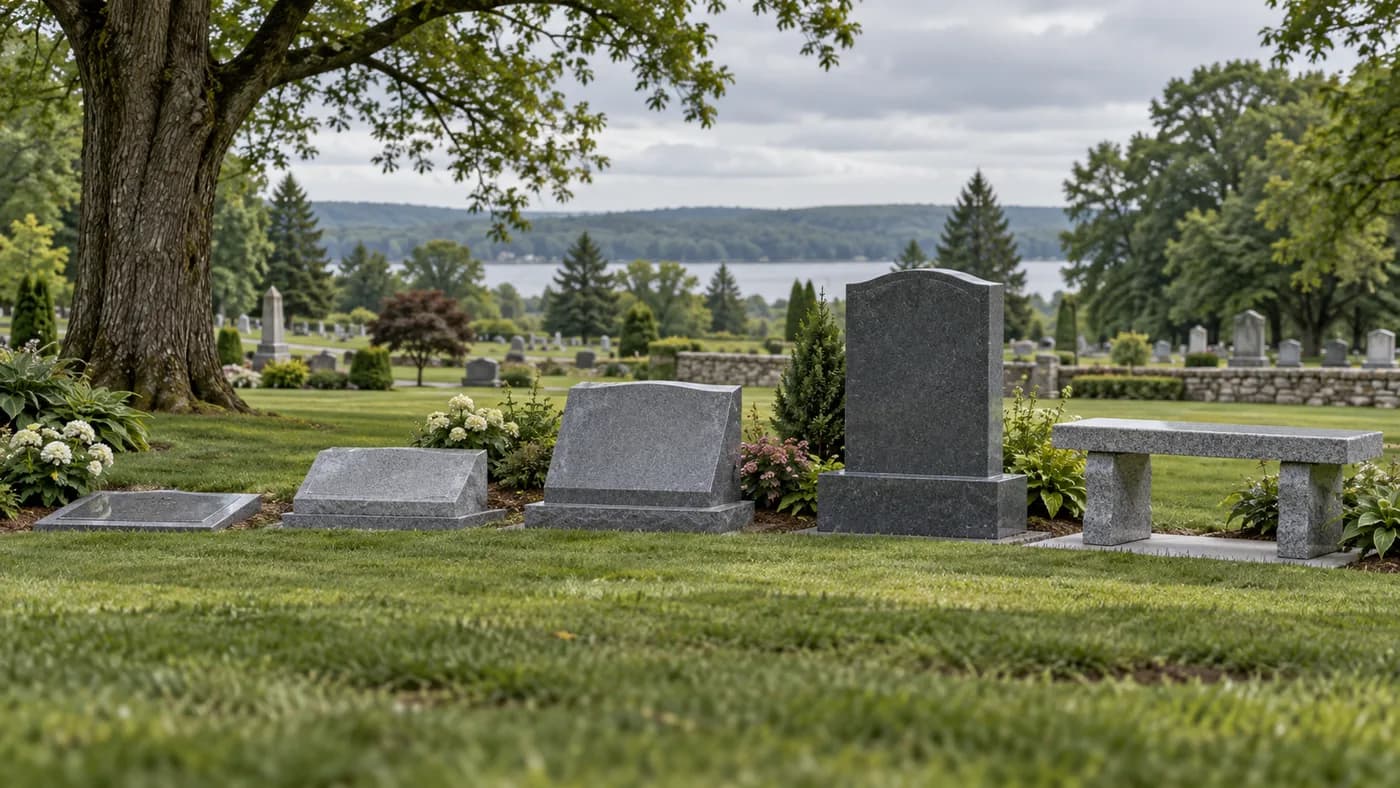
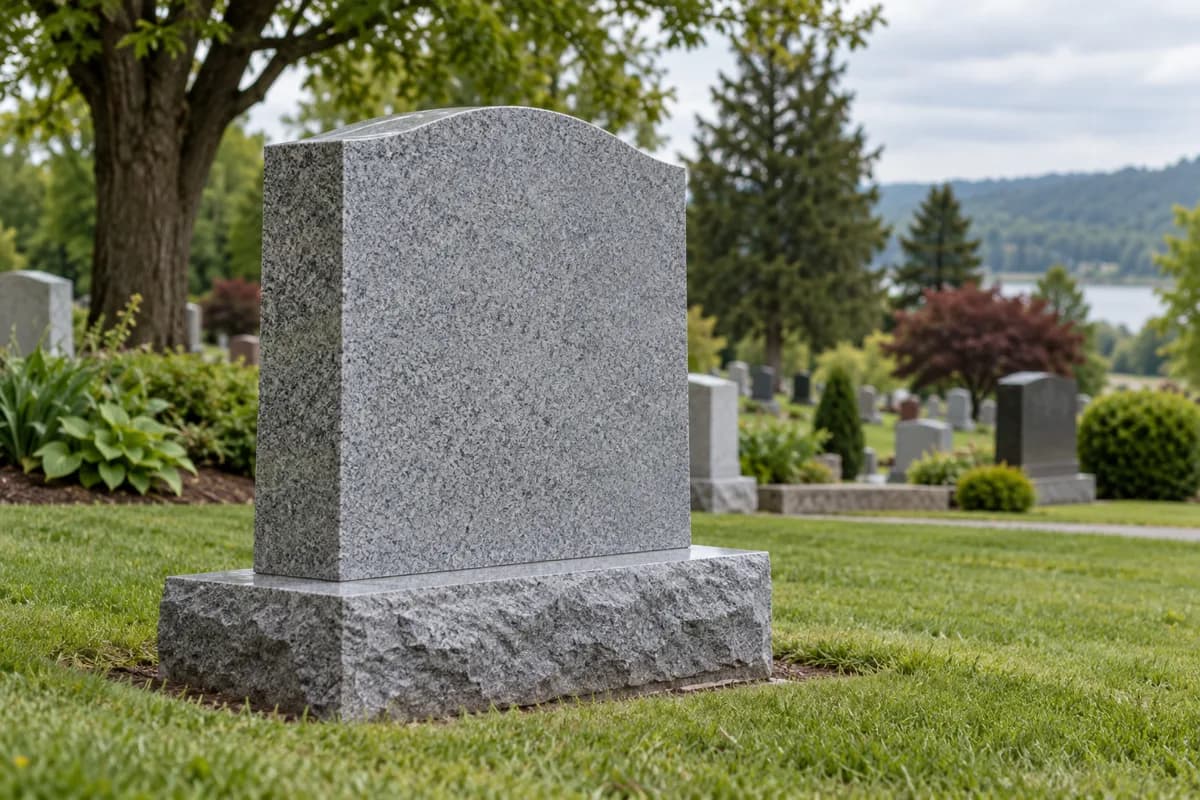
An upright headstone is a standing monument, usually a vertical tablet attached to a separate base. It gives a family room for names, dates, a longer inscription, and artwork. It also introduces decisions that a flat marker may avoid: the size and finish of two stone pieces, a foundation capable of supporting them, and a cemetery's height and placement rules. Start with the cemetery and the total installed quote, rather than a photograph of a stone with a tempting starting price.
What does an upright headstone cost?
Empathy's 2026 consumer price guide lists $1,000–$3,000 for an upright tablet and $2,000–$5,000 for a companion monument. These are national published estimates, not prices from Headstone Quotes, a local dealer offer, or a guaranteed installed total. Empathy describes its broader typical headstone figure as including stone, engraving, and installation, but its style table does not itemize each line. Ask the seller exactly what its upright price includes. A larger custom upright can exceed those estimates.
The Funeral Consumers Alliance gives a separate, undated example of perhaps $1,000 for a marker including engraving and setting. It does not identify that marker as an upright. That number should not be used as an upright quote. Both sources show why a price on a catalog page is only a starting point.
| Ask for this line | Why it matters for an upright |
|---|---|
| Tablet | Confirm width, height, thickness, granite color, and faces finished. |
| Base | Confirm its separate dimensions, finish, and whether it is included. |
| Lettering and art | Ask what is included on the front, back, and base. |
| Foundation | Identify who designs, pours, and charges for the footing. |
| Freight and delivery | A large upright is heavy; distant delivery can change the comparison. |
| Setting | Confirm who places and anchors the pieces and whether the cemetery charges separately. |
| Cemetery charges and tax | Ask about permit, inspection, foundation, and setting fees before ordering. |
Do not add the quoted price of a separate base to a package that already includes one. Likewise, do not assume the cemetery's installation bill is inside the monument company's proposal. Request one written total that names every party collecting money.
Check the grave section before designing
The Federal Trade Commission says cemeteries differ in the types of memorials they allow. The Funeral Consumers Alliance advises obtaining the cemetery's written rules and paying attention to permitted type and size. An upright may be allowed in one section and prohibited in a flat-marker section of the same cemetery.
Give the cemetery the plot and section identifiers. Ask for the current written monument rules and a fee schedule for that exact location. Confirm maximum tablet and base dimensions, materials and colors, whether both faces may be inscribed, required foundation dimensions, who must install, and the approval process. Ask if a companion stone may cross two spaces or must fit within one. Have the monument company draw to those specifications before paying a nonrefundable deposit. Our cemetery requirements guide has a fuller question list.
Do not infer a standard size from a display stone. A drawing might list a tablet 30 inches wide, but that is an example measurement, not permission for your grave. On a two-piece upright, record tablet width × height × thickness and base width × depth × height separately. Confirm whether the cemetery measures total installed height from the ground or measures the tablet alone. If the seller says a size is common, ask the cemetery to approve the actual drawing.
Choose the form before the decoration
The simplest upright is a single tablet on a base for one person. A companion upright is wider and reserves space for two names. A family monument may contain additional names, but the number of interments and the right to identify them are cemetery and plot questions, not design assumptions. Think about how the stone will read from the path and whether visitors will approach from one side or both.
The shape of the top and shoulders changes the visual character and the usable lettering space. A flat or gently curved top leaves a predictable inscription field. An elaborate carved outline consumes stone and production time and may leave less room for words. Ask the designer to show the inscription at actual proportions within the stone outline, rather than placing it on a generic mockup.
A base can be wider than the tablet and can hold a family surname or vase, if allowed. That space is not automatically available: some cemetery rules control vases and projecting accessories. Confirm that the mockup shows the base, the full footprint, and any vase or photo location. For a picture, compare porcelain inserts and laser etching with the dealer after checking the cemetery's material and attachment rules.
Materials, color, and finish
Granite is a common choice for an upright because it can be cut, polished, and lettered in several ways. Marble is another option where a cemetery permits it. The VA's marker program offers upright government headstones in granite and marble, which establishes those as recognized monument materials; it does not mean every private cemetery permits both. Ask a dealer to identify the specific stone, not merely “granite,” and show a physical sample if color is important. Natural stone varies from piece to piece.
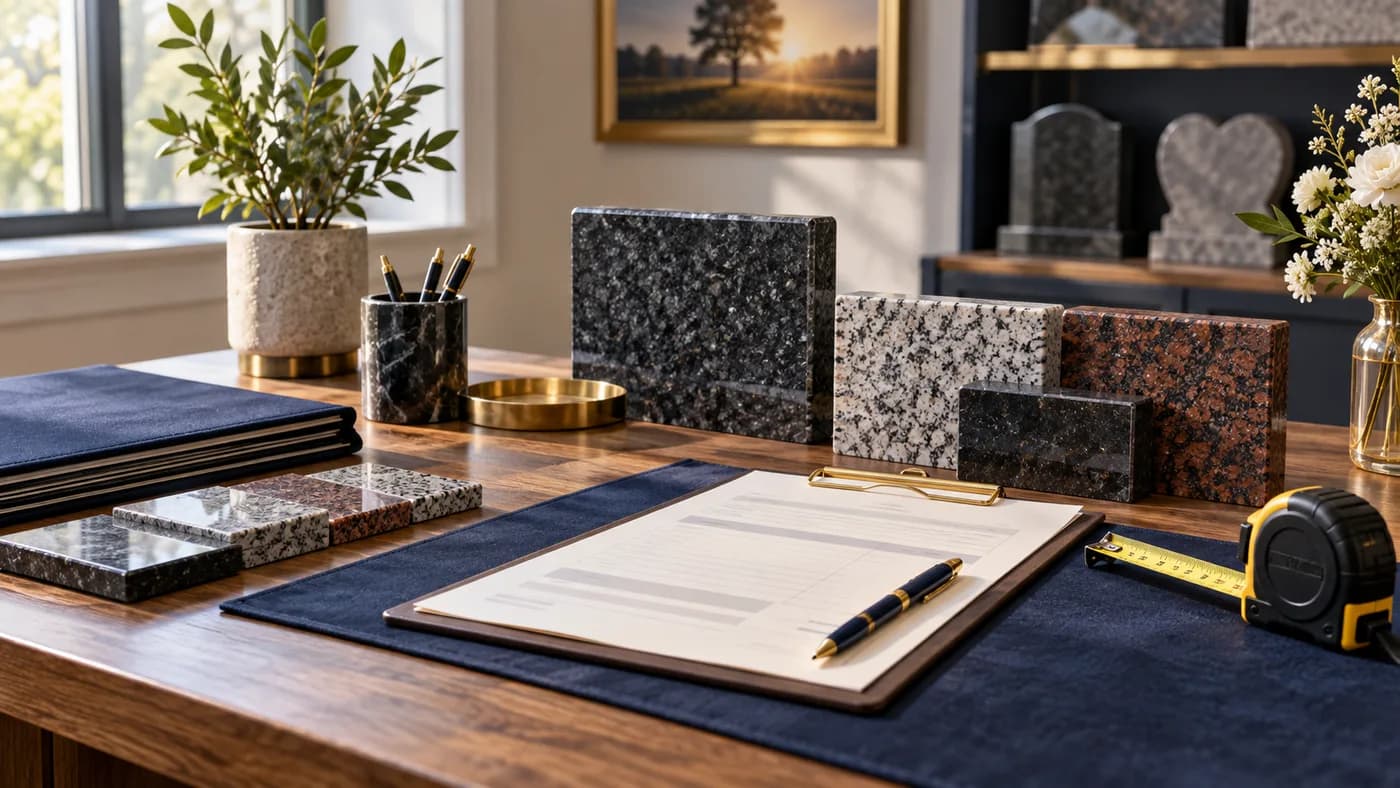
Finish choices can include polished front and back faces, polished sides, a textured edge, or carved details. More finished surfaces and hand work can change the quote. If comparing two estimates, specify the same stone color, tablet thickness, edge treatment, and finish on every visible face. A lower estimate for a rough-backed tablet is not the same product as a fully polished one. Our granite versus bronze guide explains the material choices in more detail.
Lettering and the future inscription
Decide what must be legible first: name, dates, and a short identifying line. A long poem, multiple emblems, and a portrait can compete for the same face. Ask for a proof with every letter, punctuation mark, date, accent, and line break shown. Have a second person check it against family records. The proof should state which marks are sandblasted, etched, painted, or otherwise finished; different techniques look different on different granites. Compare actual samples before choosing a technique.
For a companion stone, plan the second inscription now. Reserve adequate space, agree on the future layout, and ask whether the second name will be added on site or at a shop. The future work is not necessarily included in today's quote. Keep a copy of the approved design and lettering specifications so another family member can order matching work later. Avoid placing dates or wording that presume how that future inscription will read unless the family has agreed.
Foundation and setting
The base is the visible stone beneath the tablet. The foundation is support below ground. They are separate cost and approval items. Ask the cemetery which party may make the foundation, the approved location and dimensions, and whether it must cure before the monument is set. Then ask the seller who supplies equipment and labor to deliver, assemble, and set the upright. If one party handles only the foundation and another sets the stone, get the handoff date and responsibility in writing.
Some cemeteries charge to inspect or accept an outside monument; some handle installation themselves. The FTC's cemetery guidance supports checking restrictions, while the Funeral Consumers Alliance recommends reviewing the contract and printed price list. Neither source sets your cemetery's fees. Call the cemetery directly. Do not pay for production until the seller has the approved drawing and a workable setting arrangement.
Weather, ground conditions, production queues, and cemetery scheduling affect installation timing. Request separate estimates for design approval, carving, delivery, foundation, and setting rather than one vague completion date. Ask what happens if the stone arrives before the cemetery can accept it and who stores it.
Compare two upright quotes fairly
Send each dealer the same cemetery rules, plot details, inscription, and desired dimensions. Ask each to return a drawing and an itemized written offer. Compare the actual stone and the work, not the headline amount.
| Compare | Questions to settle |
|---|---|
| Dimensions | Are both tablet and base measured the same way? |
| Stone | Same material, color, grade description, and finish? |
| Design | Same amount of lettering, artwork, and back inscription? |
| Installation | Same foundation, delivery, setting, and cemetery fees? |
| Process | Who seeks cemetery approval and corrects a rejected drawing? |
| Aftercare | What written remedy applies to manufacturing or lettering mistakes? |
Ask which items are allowances, which are fixed, and what could change before final payment. If an online price excludes local setting, obtain a separate local installer quote before treating it as cheaper. A dealer who works regularly with your cemetery may know its workflow, but the cemetery's written approval remains decisive.
How to order an upright headstone
- Find the grave's section, lot, and space identifiers, plus the person authorized to approve a memorial.
- Request written cemetery monument rules and every applicable memorial fee.
- Choose single or companion layout and set a maximum installed budget.
- Ask comparable sellers for the same tablet, base, materials, finishes, and lettering scope.
- Review an actual scaled proof. Verify spelling, dates, line breaks, and measurements.
- Obtain cemetery approval of the drawing and confirm foundation and installation responsibilities.
- Review payment stages, change policy, production timing, and written correction terms before authorizing fabrication.
- Keep the approved drawing, invoice, material specification, and installation record.
The ordering guide covers the full process. You can request headstone quotes after gathering the cemetery details; share the same design brief with every seller.
Frequently asked questions
Is an upright always more expensive than a flat marker?
Published national style estimates generally put a simple flat marker below an upright. Your two actual installed quotes can differ for other reasons: stone, finish, artwork, freight, foundation, and cemetery charges. Compare complete proposals for the same grave. See the flat marker guide and headstone cost guide.
Does the quoted upright price include the base?
Sometimes. Ask the seller to identify the tablet and base as separate lines or state plainly that both are in the package. The drawing should show both pieces with dimensions.
Can I put two names on one upright?
A companion design can reserve two inscription areas. First confirm that the cemetery permits its width and placement for the plot. Ask how and at what future cost the second inscription can be added.
Can I buy the stone from a different company than the cemetery?
Ask for the cemetery's current written rules and fees before ordering elsewhere. The FTC notes that cemeteries set memorial restrictions; the Funeral Consumers Alliance also advises reviewing the contract. Do not assume that a funeral-home consumer rule determines a cemetery's monument policy.
What if my section allows only a low marker?
Request the written height rule, then consider a slant, bevel or pillow, or flat marker that fits it. A dealer can prepare an alternate drawing for the cemetery.
About these estimates
Price context comes from Empathy's 2026 headstone cost guide and the Funeral Consumers Alliance cemetery guide. Cemetery-rule advice is supported by the FTC's Buying a Cemetery Site. Material examples come from the VA National Cemetery Administration. These sources provide US consumer guidance and published estimates, not a price or approval for a particular cemetery. Confirm local rules and obtain current written quotes.

Request written quotes
Describe the cemetery, style, material, and inscription once, then deliberately send a serious inquiry to participating monument companies for real prices.
Request free quotesSources and scope
This guide provides general educational information, not a quote or a statement of any cemetery’s rules. Confirm requirements and prices directly with the cemetery and monument provider.