Material comparison
Granite vs. Bronze Grave Markers
Compare appearance, design flexibility, cemetery compatibility, maintenance, and cost structure before choosing granite or bronze.
Published by HeadstoneQuotes · Sources last verified September 14, 2026 · 8 min read
Last verified: September 14, 2026
The short answer
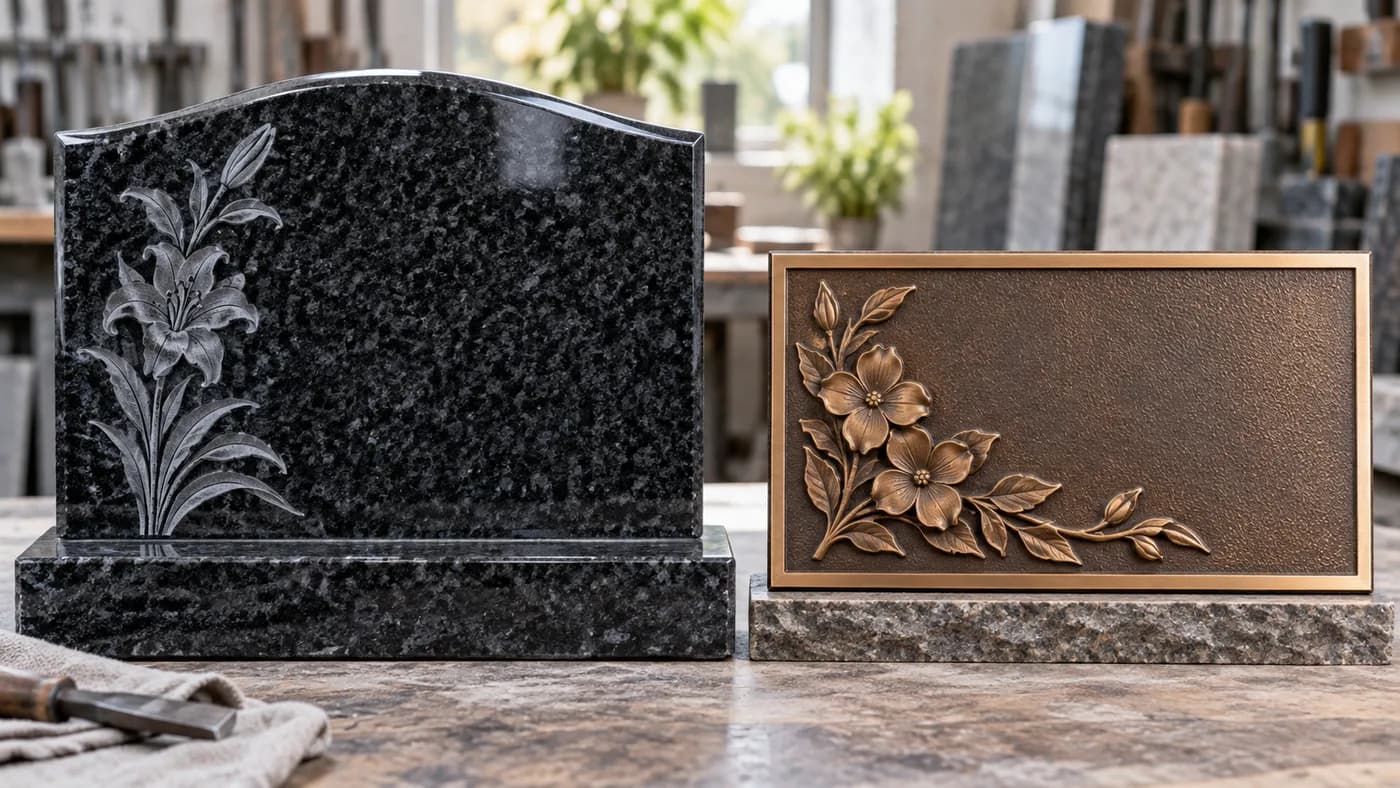
Granite is stone: the marker itself carries the inscription, cut into the surface. Bronze is a cast metal plaque: the inscription is raised, and the plaque is almost always mounted on something — usually a granite base.
So the real comparison is rarely "granite or bronze." It is usually "granite marker" or "bronze plaque on a granite base." That matters for your budget and for the questions you ask the cemetery.
And often the choice is not yours. Many cemetery sections specify one material — frequently flat bronze, because it mows cleanly. Check that first.
Side by side
| Granite marker | Bronze marker | |
|---|---|---|
| What it is | A finished piece of stone | A cast metal plaque, typically lead-free bronze |
| Inscription | Cut into the surface, by sandblasting or laser | Raised from the surface, cast in |
| Usually mounted on | Its own base (upright) or set directly (flat) | A granite base, in most flat-marker installations |
| Surface change over time | Very slow; polish can dull; lichen and soiling accumulate | Develops a patina, changing colour over years |
| Colour options | Wide range of natural stone colours | Bronze, with a choice of background treatments |
| Photographic portrait | Laser etching works on dark polished granite; porcelain photos can be mounted on either | Porcelain photos can be mounted; laser etching is not a bronze technique |
| Repair after damage | Stone can chip or crack; matching a repair is difficult | Can be refinished; a missing plaque must be recast |
| Typical relative cost | Lower for a comparable flat marker | Higher for a comparable flat marker |
For dollar figures with their sources and dates, see how much a headstone costs.
Bronze usually comes with granite
A flat bronze marker is not simply laid on the ground. It is mounted — commonly on a granite base that sits at ground level, giving the plaque a rigid, level bed and a defined border. Manufacturer documentation describes bronze memorials as mounted using blind-stud fittings, and notes that custom vase positions may require a custom granite base (Gemini Incorporated, December 2024).
Three consequences worth planning around:
- You are buying two components. The bronze plaque and the granite base are separate items with separate costs.
- The cemetery may specify both. Some cemeteries dictate the base's dimensions and even its colour, so the base is not always a free choice.
- Comparing quotes gets harder. One quote may include the base, another may not. Ask explicitly.
This is the single most commonly omitted fact in bronze-vs-granite comparisons. Confirm with your cemetery and monument company what your installation requires — a granite base is a common arrangement, not a universal rule.
Durability, without the myths
You will read confident claims that one material "lasts forever" or "lasts 500 years." We do not publish service-life figures for either material, because we have not found a source that can support one, and a marker's life depends on the stone or alloy, the climate, the setting, and the care it gets.
What can be said honestly:
- Both granite and bronze are chosen for outdoor memorial use precisely because they endure outdoors for a very long time. Neither is a short-term material.
- Granite is hard and chemically stable. Its failure modes are physical — chipping, cracking from impact or from a settling foundation — plus gradual surface soiling and biological growth.
- Bronze does not rust. It reacts with the atmosphere and changes colour. Its failure modes are surface wear on the raised lettering over long periods, loosening of the mounting, and damage or loss through theft or impact.
- The foundation often determines how a marker ages more than the material does. A marker that tilts or sinks looks neglected regardless of what it is made of.
Patina: what bronze looks like in ten years
Bronze changes colour outdoors. It is a normal surface reaction, not a fault, and it is expected in the product: manufacturers offer a standard clear-coat finish along with semi-gloss, satin and matte options, and will produce an oxidised background on request — that is, a deliberately darkened finish (Gemini Incorporated, December 2024).
Practically: if you want the plaque to look as it does in the showroom for as long as possible, ask about the finish specified on your order and what maintenance the manufacturer recommends. If you would rather it weather into a darker, softer look, that will happen on its own. Neither is wrong — but decide knowingly, because families are sometimes distressed by a change nobody warned them about.
Caring for either marker — and what will damage it
The most useful public guidance on cleaning markers comes from the US National Park Service's National Center for Preservation Technology and Training. Two limits on it, stated up front: it is written for government-issued headstones and addressed to cemetery staff and contractors, and it does not cover whether a family needs the cemetery's permission first. Ask your cemetery before cleaning any marker. Many have their own rules, and some do the work themselves.
With those limits noted, the guidance (updated April 2025) says:
- For biological growth such as algae, moss and lichen, use a biocidal cleaner intended for the purpose — it names D/2 Biological Solution and Enviro Klean® BioWash® — following the manufacturer's instructions.
- Pre-wet the stone and "agitate the surface gently in a circular motion using a soft bristle brush," working from the bottom upward.
- Do not use bleach or bleach-like products, strong acids such as muriatic or hydrochloric acid, "harsh mechanical devices such as sand blasting, or power tools such as sanders or drills," or pressure washing above 500 psi.
- Clean rarely: "historic headstones should not be cleaned more frequently than once a year."
The damaging shortcuts — wire brushes, household bleach, a pressure washer — are exactly the ones that feel effective in the moment and cause irreversible harm. Less, gently, and rarely.
For bronze specifically, follow the manufacturer's instructions for the finish that was specified on your order; a clear-coated plaque and an oxidised one are not the same surface.
What each costs, in direction
For a comparable flat marker, bronze generally costs more than granite — and remember to add the granite base. Published national ranges bear that direction out, and you will find them, with their publishers and dates, on how much a headstone costs. We keep all dollar figures on that page so they stay current in one place.
Do not choose on price direction alone. If the cemetery mandates one material, the comparison is moot; if it does not, the difference over the life of the marker is mostly about appearance and maintenance, not about durability.
When the cemetery decides for you
Cemeteries restrict what they permit. The Federal Trade Commission's consumer guidance notes cemeteries differ in "the type of monuments or memorials it allows," and the Funeral Consumers Alliance notes a cemetery "can refuse to accept one deemed inappropriate."
Bronze-only sections are common, usually for groundskeeping reasons. Before you compare anything, ask your cemetery which materials are permitted in your specific section, and whether the base is specified too. Our cemetery requirements guide has the questions.
This describes how cemeteries commonly operate. It is not a statement about any particular cemetery's rules.
How to choose
- If the cemetery specifies a material, that settles it — spend your attention on the design instead. See granite colours and finishes or, for bronze, the background finish options.
- If you want a photographic portrait etched into the marker, that points to dark polished granite; etching is a stone technique. A mounted porcelain photo can go on either. See porcelain photos vs. laser-etched portraits.
- If you want the widest choice of colour and shape, granite.
- If you want the traditional raised-letter plaque look, or the cemetery's section is uniform bronze, bronze.
- If a VA-furnished marker is involved, note that VA offers flat markers in granite, marble and bronze, and upright headstones in granite and marble — see veterans' headstones and VA markers.
Frequently asked questions
Do bronze markers need a granite base? Very commonly, yes — but confirm it for your installation. It affects both the price and what the cemetery requires.
Does bronze turn green? Bronze develops a patina and darkens or changes colour outdoors over years. The specified finish influences how quickly and how much.
Can I put a photo on a bronze marker? A mounted porcelain photo, yes. Laser etching is a technique for dark polished stone, not for bronze.
Which is easier to repair? Neither is simple. Bronze can often be refinished in place or removed and reworked; a cracked or chipped granite marker is difficult to repair invisibly. Ask any company you are considering what their warranty covers.
Request written quotes
Describe the cemetery, style, material, and inscription once, then deliberately send a serious inquiry to participating monument companies for real prices.
Request free quotesSources and scope
This guide provides general educational information, not a quote or a statement of any cemetery’s rules. Confirm requirements and prices directly with the cemetery and monument provider.