Flat markers
Flat Grave Markers: Prices and Buying Guide
Compare granite and bronze flat grave markers, understand installed costs, and check size, foundation, and setting rules before buying.
Published by HeadstoneQuotes · Sources last verified October 5, 2026 · 11 min read
Last verified: October 5, 2026
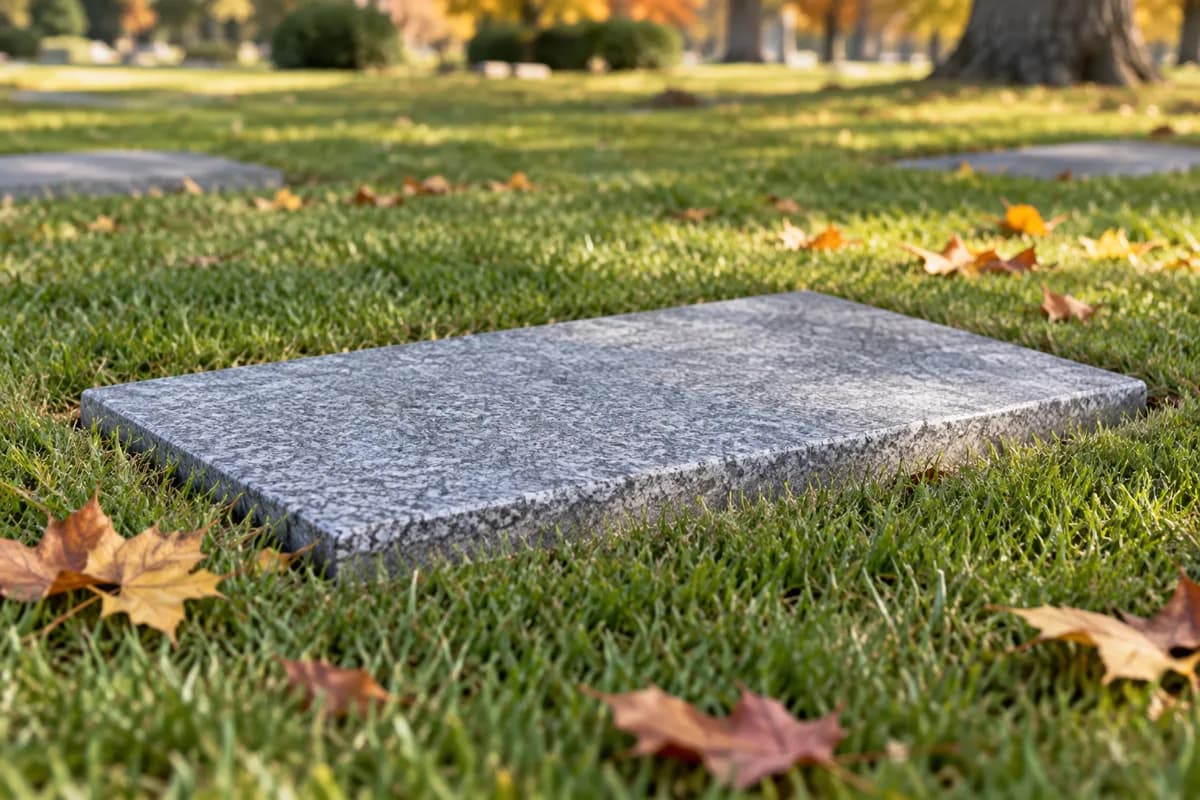
A flat grave marker sits level with or close to the turf. It may be a granite stone with lettering cut into its face or a bronze plaque mounted on a stone or concrete support. A cemetery may call it a grass marker, lawn marker, flush marker, or flat marker. Those words do not guarantee identical products. Before comparing prices, establish the exact material, dimensions, support, and setting method your grave section allows.
What does a flat grave marker cost?
Empathy's 2026 headstone cost guide publishes $200–$1,000 for a flat or grass marker. Its material discussion separately estimates a standard single bronze marker at $2,500–$3,500. These figures are national editorial estimates from another organization; they are not Headstone Quotes marketplace data, a supplier price list, or a promise of an installed total. The very different bronze figure is a reminder to name the material before using a “flat marker” average. Empathy's style table does not specify which fees are included in every range.
The Funeral Consumers Alliance describes perhaps $1,000 for a marker including engraving and setting in its undated cemetery guide. That example does not identify a material or size. Use it only as background. Your usable number is the complete local quote for the marker your cemetery will accept.
| Cost component | Ask the seller or cemetery |
|---|---|
| Marker | Is the quoted object granite, bronze, or bronze mounted on stone? |
| Support | Does a bronze plaque need a granite base or a concrete foundation? |
| Lettering | Are name, dates, emblems, and finish in the quoted price? |
| Freight | Is delivery to the cemetery included? |
| Setting | Who installs it flush with the approved grade? |
| Cemetery fees | Are permit, inspection, foundation, or installation charges separate? |
| Tax | Is applicable tax included in the written total? |
Make sellers state the installed total and identify any charge paid directly to the cemetery. A low online stone price can be useful, but it is not a comparable bid until delivery and local installation are known.
The first decision: granite or bronze
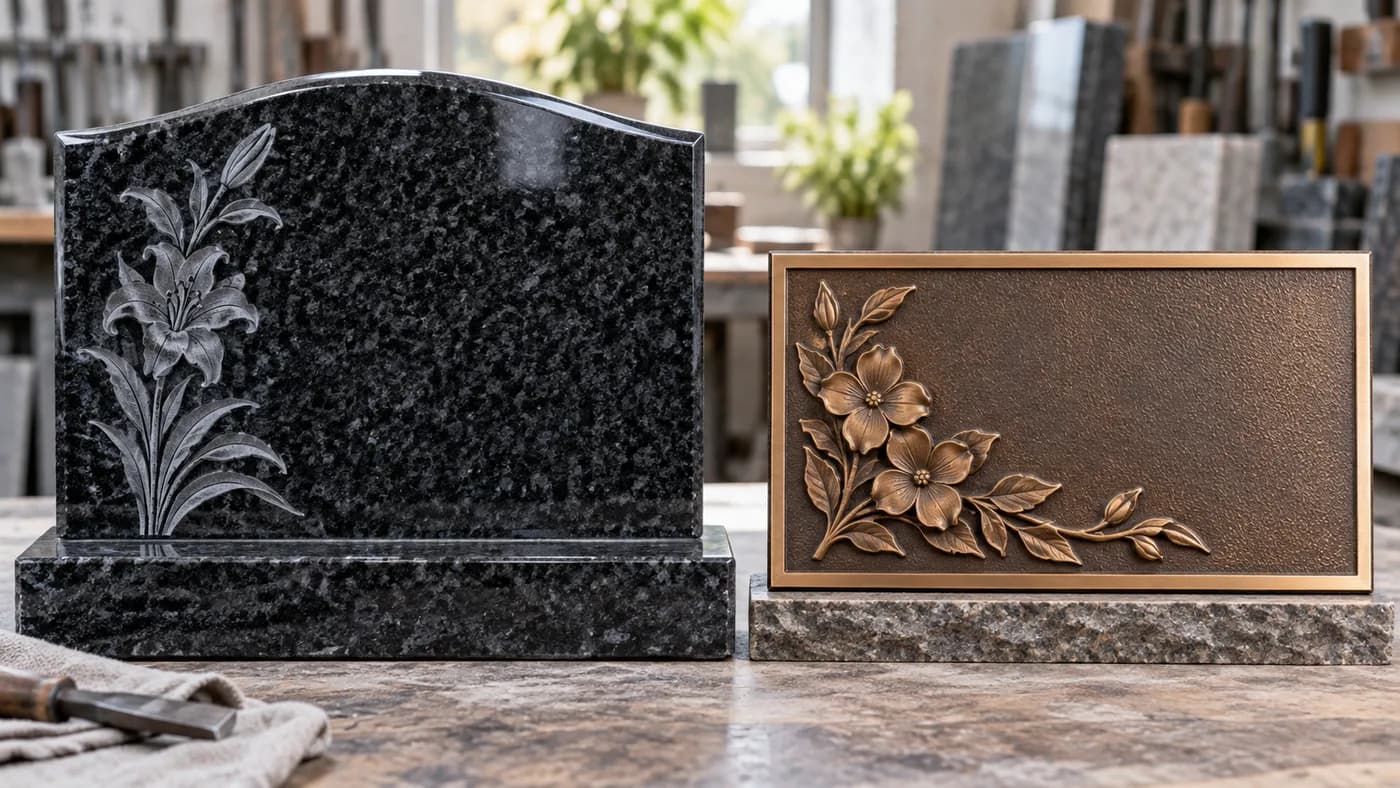
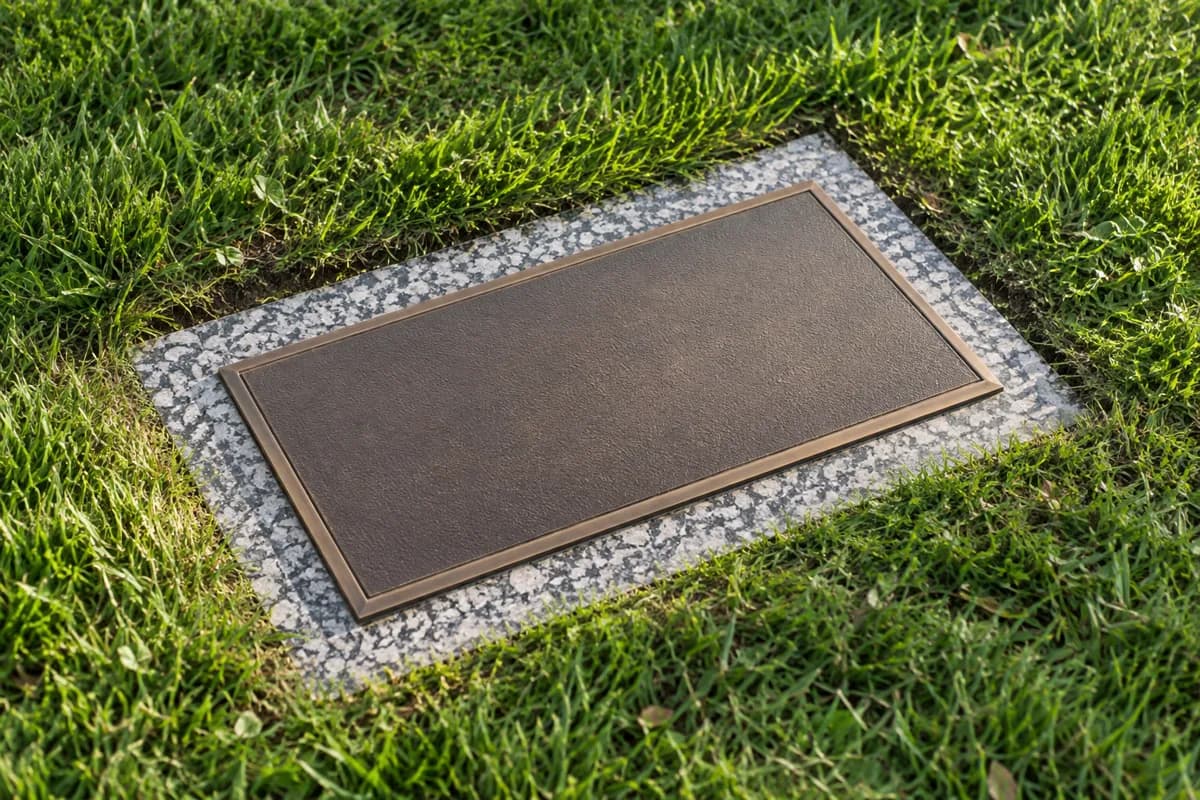
A granite flat marker is one stone piece whose surface is engraved or etched. Color, finish, size, and detail affect the offer. A bronze marker is a cast plaque, often attached to a separate support. It may have raised lettering and designs. Ask how the plaque is fastened and whether the support is included. The VA National Cemetery Administration offers flat government markers in granite, marble, and bronze; that shows material choices exist, but private cemetery rules differ.
Some cemetery sections specify bronze only, granite only, or a particular combination. Others regulate the visible dimensions and the distance from the turf. Do not switch materials after receiving a cemetery approval: the approved drawing may no longer apply. See granite versus bronze markers for a deeper comparison, then confirm the rule for the actual plot.
If a seller quotes “bronze on granite,” request the plaque dimensions, support dimensions, metal finish, attachment method, and the wording on both parts. A bronze plaque's size is not necessarily the same as the overall footprint. If a vase is offered, check whether a vase unit or hole changes the allowed size or the cemetery's mowing requirements.
What flat really means at your cemetery
The FTC says cemetery memorial rules vary. The Funeral Consumers Alliance advises getting the contract and rules, especially limits on monument type and size. Some sections require a marker completely flush with the ground; others permit a low raised edge. A catalog photograph cannot settle that distinction.
Ask the cemetery for a written rule tied to the grave's section and plot. Confirm maximum length, width, and thickness; material and color; whether a border or base is required; what “flush” means in that section; and which party supplies the foundation or setting. Ask whether the monument maker needs to submit a drawing before production. If the grave is new, confirm when the cemetery will accept installation. Our cemetery requirements guide provides a complete checklist.
For dimensions, record both the visible marker and its support. If the cemetery limits a 24-inch width, ask whether that applies to the plaque, the granite support, or the whole installed assembly. No universal flat-marker dimension should override a section rule. Your drawing should state width × length × thickness and show the direction of the grave and inscription.
Design for a smaller reading area
Flat markers usually have less inscription space than uprights. The surface is viewed from above, and grass or decorations may partly obscure an edge. Prioritize the person's name and dates, then fit a short line, emblem, or motif if the layout remains clear. Ask to see a scaled proof, not just a decorative preview. Check actual lettering height and spacing.
A companion flat marker needs room for two names and possibly two sets of dates. If the second inscription is left blank, ask how it will be added later and whether the cemetery permits onsite work. Record the exact font, lettering method, and layout in the order documents. A maker may offer a polished border, carved flower, religious emblem, or portrait; each takes space. Ask to see samples of the proposed lettering and portrait methods before approving the proof.
Proofread the inscription with another family member. Verify names against records, including middle initials, accents, and date order. A production error may be correctable only by remaking a stone or plaque, so know the seller's written correction terms before approval.
Foundation, setting, and upkeep
A flush marker still needs a stable approved setting. The cemetery may provide the foundation, require a monument company to do it, or specify a particular base. Ask who is responsible for leveling the marker after installation and what happens if ground settlement changes its position. Do not assume that a flat marker has no foundation charge simply because it has no visible upright base.
Confirm access and scheduling with the cemetery. The seller might deliver to its receiving area while cemetery staff set the marker on a later date. Ask for a delivery receipt and a completion notice. If a bronze plaque and stone support come from different suppliers, identify who assembles and inspects them before setting.
Care depends on material and finish. Request the maker's cleaning instructions and the cemetery's decoration rules. Avoid treating a stone marker as a household countertop; harsh cleaners or abrasion can alter lettering or finish. The National Park Service's guidance for government-issued headstones is a useful conservation reference, though it is not a product-specific warranty for a private marker.
How to compare flat-marker quotes
Give each seller one specification: cemetery name and section, permitted dimensions, chosen material, single or companion layout, inscription, optional art, and installation location. Then compare the bids line by line. A bronze quote may include its plaque but omit the granite support; a granite quote may include standard names and dates but charge separately for an emblem. Ask what “standard lettering” means in characters, lines, or design area.
| Compare | Why it changes the offer |
|---|---|
| Material and support | Bronze plaque, granite block, and bronze-on-granite are different assemblies. |
| Size and thickness | More material and weight can affect production and freight. |
| Lettering | Cast, sandblasted, and etched designs have different work scopes. |
| Finish | Polished face, border, and other finish details may vary. |
| Delivery and setting | An online listing may exclude both. |
| Cemetery approval | A seller should say who submits and revises the drawing. |
If the bids differ widely, ask each seller to mark what is missing rather than assuming the highest is overcharging. A fair comparison uses the same approval-ready design and the same installed endpoint.
Ordering steps
- Obtain the plot and section number and the cemetery's current written flat-marker specifications.
- Decide on granite, bronze, or the permitted combination; confirm the support and overall footprint.
- Write the exact inscription and decide whether a second name will be added later.
- Request comparable, itemized bids that include delivery, setting, and known cemetery fees.
- Check a scaled proof for orientation, spelling, dimensions, and material notes.
- Secure cemetery approval before the marker is fabricated.
- Keep the proof, receipt, warranty terms, and installation confirmation.
The broader headstone ordering guide walks through these stages. Once the cemetery rules are in hand, request quotes with the same details for each maker.
Frequently asked questions
Are flat markers always the cheapest headstones?
A simple granite flat marker is often at the low end of published style estimates. A bronze plaque, companion size, elaborate casting, or special foundation can cost substantially more. Compare actual installed totals, not category labels. See headstone costs.
Does a flat marker need a foundation?
It may. Requirements depend on the cemetery and the marker assembly. Ask who supplies the support and who pays to set it; never infer “no foundation” from “flat.”
Can I add a vase or photo?
Only if the cemetery permits it and the chosen marker can accommodate it. Ask for the accessory's exact position and dimensions on the approval drawing.
What is the difference between flat and bevel?
A flat marker is designed to sit level with the ground; a bevel marker has a low raised, sloping face. That small height difference may determine whether your cemetery accepts it.
Can two people share one flat marker?
Yes, a companion design can accommodate two inscriptions where plot and cemetery rules permit the size. Agree on the future inscription method and space before the first inscription is made.
About these estimates
Price examples: Empathy, 2026 and the undated Funeral Consumers Alliance cemetery guide. Restrictions: FTC, Buying a Cemetery Site. Material examples: VA National Cemetery Administration. Cleaning context: National Park Service. All price figures are third-party US estimates, not local quotes. Cemetery approval and the current installed price must be obtained for the specific grave.
Request written quotes
Describe the cemetery, style, material, and inscription once, then deliberately send a serious inquiry to participating monument companies for real prices.
Request free quotesSources and scope
This guide provides general educational information, not a quote or a statement of any cemetery’s rules. Confirm requirements and prices directly with the cemetery and monument provider.