Design guide
Headstone Types and Styles
A plain-language comparison of upright, flat, bevel, slant, ledger, bench, and companion memorials—and where cemetery rules fit in.
Published by HeadstoneQuotes · Sources last verified September 14, 2026 · 8 min read
Last verified: September 14, 2026
The short answer
Grave markers come in a handful of recognised shapes. Upright monuments stand on a base. Flat markers lie level with the ground. Slant, pillow and bevel markers sit low and are distinguished mainly by the angle of their face. Ledger stones cover the grave. Benches and specialty pieces are custom work.
Before you fall in love with a style, check one thing: your cemetery may not permit it. The Federal Trade Commission's consumer guidance notes that cemeteries differ in "the type of monuments or memorials it allows," and the Funeral Consumers Alliance notes that cemeteries limit "the type and size of monuments that are allowed, since the cemetery can refuse to accept one deemed inappropriate." That is why this guide puts restrictions next to every style rather than at the end.
These are general statements about how cemeteries operate. They are not a description of any particular cemetery's rules. Confirm yours directly — our cemetery requirements guide shows you what to ask.
The six styles you will be asked to choose between
These are the same six categories our request form asks about, so working through them here is direct preparation for requesting quotes.
Upright monument
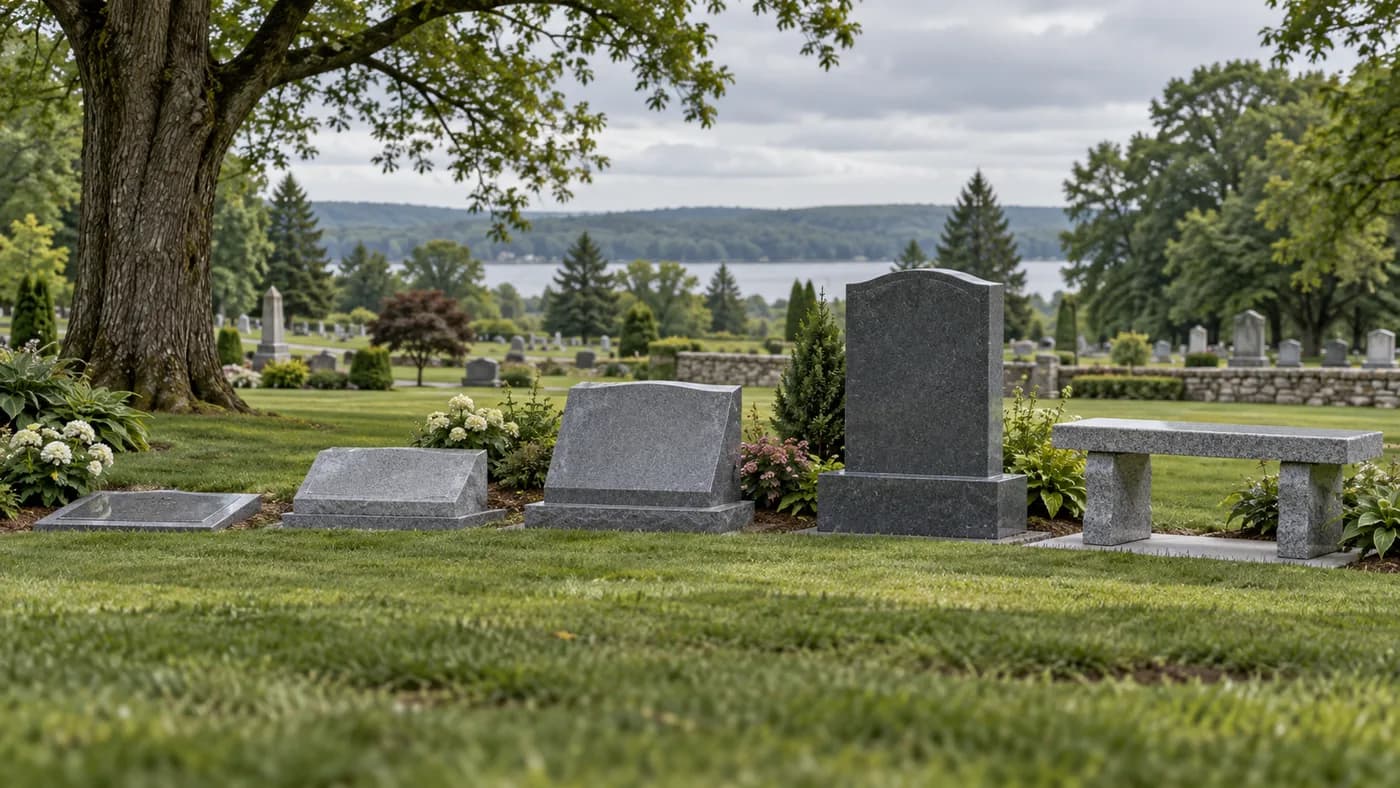
A standing stone on a separate granite base. The traditional headstone shape, and the one that offers the most face area for lettering, artwork, a portrait or vases. Because it stands above ground, it is also the style cemeteries most often restrict — some sections permit only flat markers so that mowing is unobstructed.
Flat or grass marker
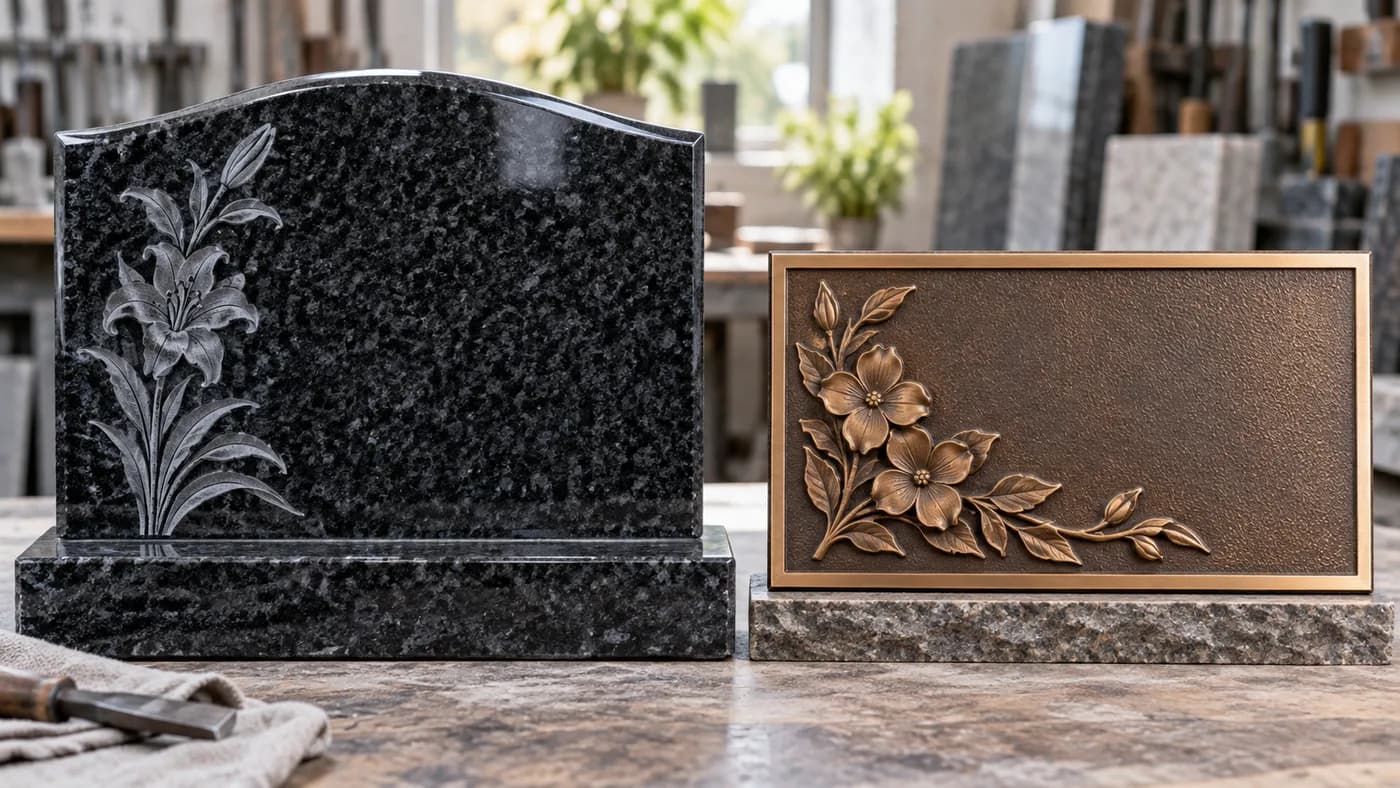
A marker set level with the ground, in granite or bronze. Requires the least material, usually needs no base, and is the style most widely permitted. A flat marker gives you less face area, which constrains long inscriptions and large portraits.
Slant marker
An angled face on a low base — upright enough to read while standing, low enough to satisfy many height restrictions. A common compromise where a full upright is not allowed.
Pillow and bevel markers
Low markers that rise slightly toward the back, so the face tilts gently upward. A pillow marker is the lower, rounder form; a bevel is the squarer, wedge-shaped one. Both read better than a fully flat marker without standing up.
Ledger stones
A large slab covering all or most of the grave. Substantial, expensive to produce and to set, and often subject to specific cemetery rules about foundations and ground settlement.
Bench and specialty monuments
Benches, sculpted forms, and other custom shapes. These are bespoke commissions. Expect a longer design conversation, a higher price, and the most scrutiny from the cemetery.
Compare the styles at a glance
| Style | Profile | Usually sits on | Face area for inscription | Commonly restricted because |
|---|---|---|---|---|
| Upright monument | Stands vertically | Granite base, on a foundation | Largest | Height; some sections are flat-marker only |
| Flat / grass marker | Level with turf | Often set directly; sometimes a foundation | Smallest | Rarely restricted; usually the permitted default |
| Slant marker | Angled face, low | Low base, usually on a foundation | Moderate | Height limits |
| Pillow / bevel | Low, gently raised back | Often a foundation, rarely a full base | Small to moderate | Height limits |
| Ledger | Covers the grave | Engineered support / foundation | Large | Ground settlement and mowing access |
| Bench / specialty | Varies | Custom footing | Varies | Size, permanence, maintenance obligations |
Restriction reasons are the general patterns cemeteries cite. Your cemetery decides its own rules.
What the marker sits on: bases and foundations
Two different things, often confused, and both can appear on your bill.
- A base is a separate piece of stone the monument stands on. Uprights and slants normally have one. Flat markers normally do not. A base is part of the monument order.
- A foundation is a concrete footing in the ground that keeps the marker level over time. Whether one is required, who pours it, and who bills you for it varies by cemetery. Some cemeteries pour foundations themselves and charge for it; some let the monument company do it; some graves already have one.
Ask the cemetery about the foundation before you finalise a style. This is one of the most common sources of an unexpected charge — see how much a headstone costs for how it fits into the total bill.
One person or two: single and companion memorials
A single marker commemorates one person. A companion marker is designed for two — typically a couple — either as one wider stone or as a pair. Companion markers need more face area, which means a larger stone, and they raise a practical question worth settling early: if only one inscription is being cut now, how will the second be added later, and what will that cost? Ask for that answer in writing while the company still has your design on file.
Size — and why the cemetery usually decides it
Markers are described by width × height × thickness. There are widely used sizes for each style, but we deliberately do not publish a size chart here, for two reasons:
- The cemetery's limits come first. Many cemeteries set maximum dimensions by section. A size chart that contradicts your cemetery's rules is worse than no chart.
- The monument company will size it properly. Given your style, your plot and your inscription, they can recommend dimensions that fit both the rules and the lettering.
If you do not know what size you want, that is a perfectly good answer — the request form lets you say so and lets the monument company recommend one.
Flat or upright? How to choose
This is the decision most families are actually making. A short way through it:
- Does the cemetery allow an upright at this plot? If not, the decision is made. Confirm before anything else.
- How much needs to go on the stone? Two names, four dates and an epitaph need more room than one name. A portrait needs a dedicated area, and so does a vase. If you want several of those, an upright or a larger companion stone will be easier to lay out. See porcelain photos vs. laser-etched portraits.
- How will it be maintained? Flat markers are mown over and can become obscured by turf; uprights stay visible but present more surface to weather and to lichen.
- What is the budget shape? An upright costs more than a comparable flat marker — more stone, plus a base, plus usually a foundation and a more involved setting.
How style affects price
Directionally, from least to most expensive for a comparable specification: flat marker → pillow/bevel → slant → upright → companion upright → ledger → bench or specialty.
That ordering holds for like-for-like work. It can flip in real cases — a large bronze flat marker can cost more than a small granite upright, and a plain companion stone can cost less than a heavily carved single one. Material matters as much as style; see granite vs. bronze markers and granite colours and finishes.
For actual figures, published ranges and the full list of what you pay for, see how much a headstone costs. We keep dollar amounts on that one page so they carry their sources and dates in one place.
Request written quotes
Describe the cemetery, style, material, and inscription once, then deliberately send a serious inquiry to participating monument companies for real prices.
Request free quotesSources and scope
This guide provides general educational information, not a quote or a statement of any cemetery’s rules. Confirm requirements and prices directly with the cemetery and monument provider.