Step-by-step
How to Order a Headstone
A calm, step-by-step checklist—from locating the plot and confirming cemetery rules to reviewing the proof and arranging installation.
Published by HeadstoneQuotes · Sources last verified September 14, 2026 · 10 min read
Last verified: September 14, 2026
Ordering a marker is not complicated, but it is out of order from what most people expect. The first two steps have nothing to do with choosing a stone — and skipping them is the most common reason a family has to start again.
The nine steps, in order
- Confirm who has the right to place a marker on the grave.
- Ask the cemetery what it permits, and get the answer in writing.
- Decide roughly what you want.
- Get quotes you can compare.
- Choose a monument company.
- Approve the design proof.
- Fabrication.
- Foundation and setting.
- Inspect the finished marker.
Step 1 — Confirm who has the right to place a marker
Cemeteries do not let just anyone place a monument on a grave. The person who holds the interment right — often evidenced by a deed, a certificate, or a purchase record held by the cemetery office — is normally the one who must authorise a marker, or give written permission for someone else to.
If you are not sure who holds it, call the cemetery office and ask. In families where a plot was bought decades ago, this single question can take a week to resolve, so it is worth asking before you start choosing stone.
Step 2 — Ask the cemetery what it permits, and get it in writing
Cemeteries restrict what they allow. The Federal Trade Commission's guidance on buying a cemetery site notes cemeteries differ in "the type of monuments or memorials it allows," and the nonprofit Funeral Consumers Alliance notes that a cemetery "can refuse to accept one deemed inappropriate."
So ask, before you order, about the permitted styles and maximum dimensions for your specific section, whether a foundation is required and who pours it, what the cemetery charges to set a marker, whether any permit or application is needed, and whether the cemetery requires you to buy from them. The Funeral Consumers Alliance records that some cemeteries "can insist that the customer buy the headstone from them," and that some "impose a ludicrous 'inspection fee' for markers purchased elsewhere" — both are worth knowing before you shop, not after.
Get the answer in writing. A verbal yes from whoever answered the phone is not something you can hold up when a stone arrives and is refused.
Our cemetery requirements guide has the full question checklist and explains what a written approval should contain.
Cemetery rules vary. Nothing on this page describes any particular cemetery's policy.
Step 3 — Decide roughly what you want
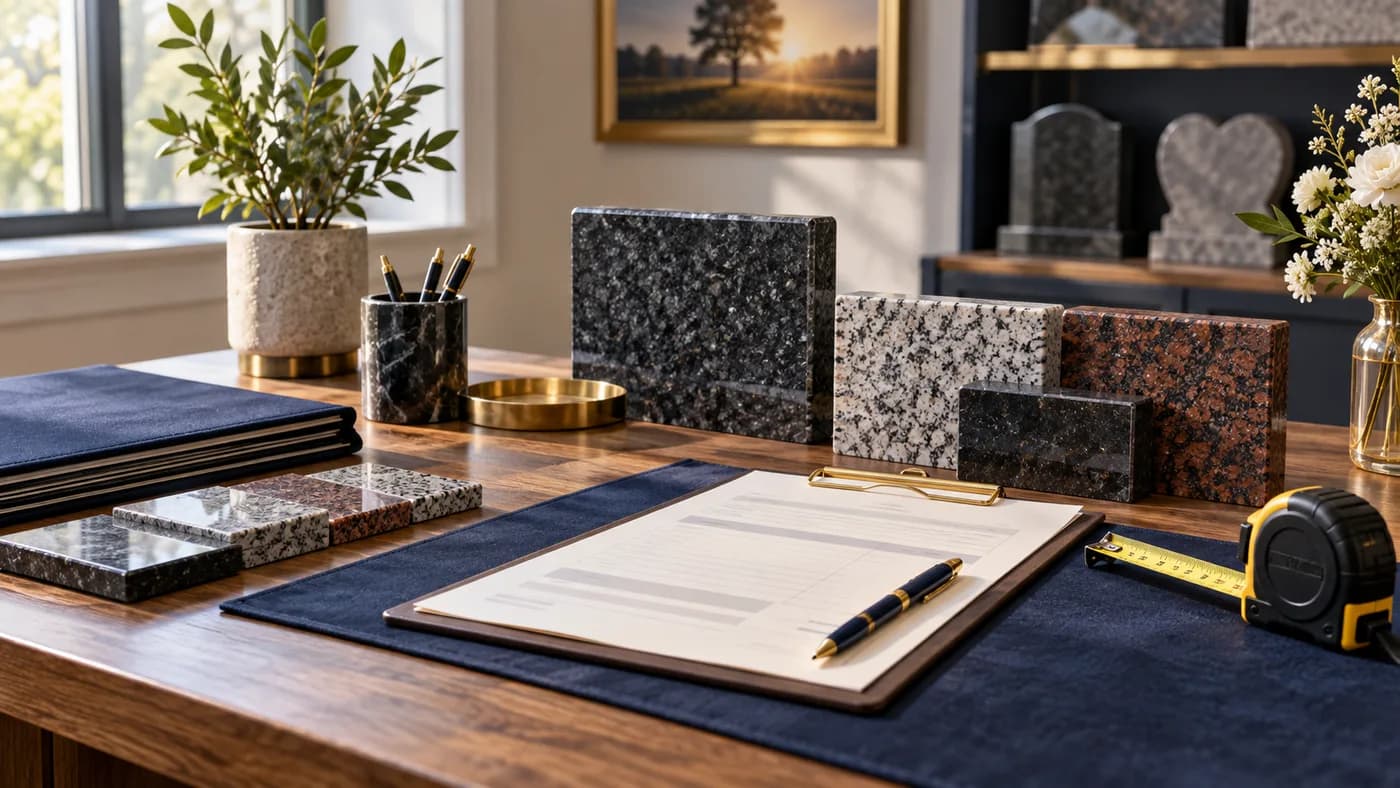
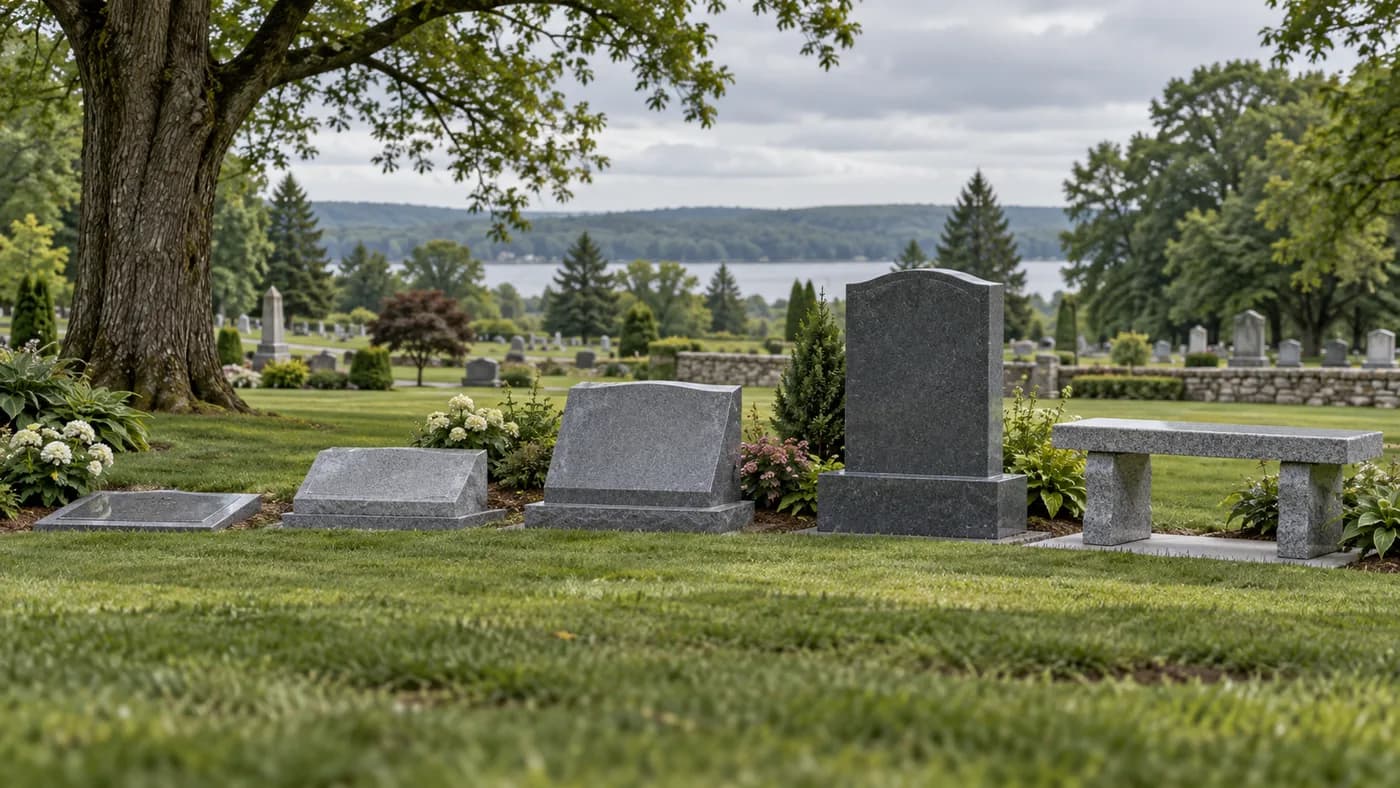
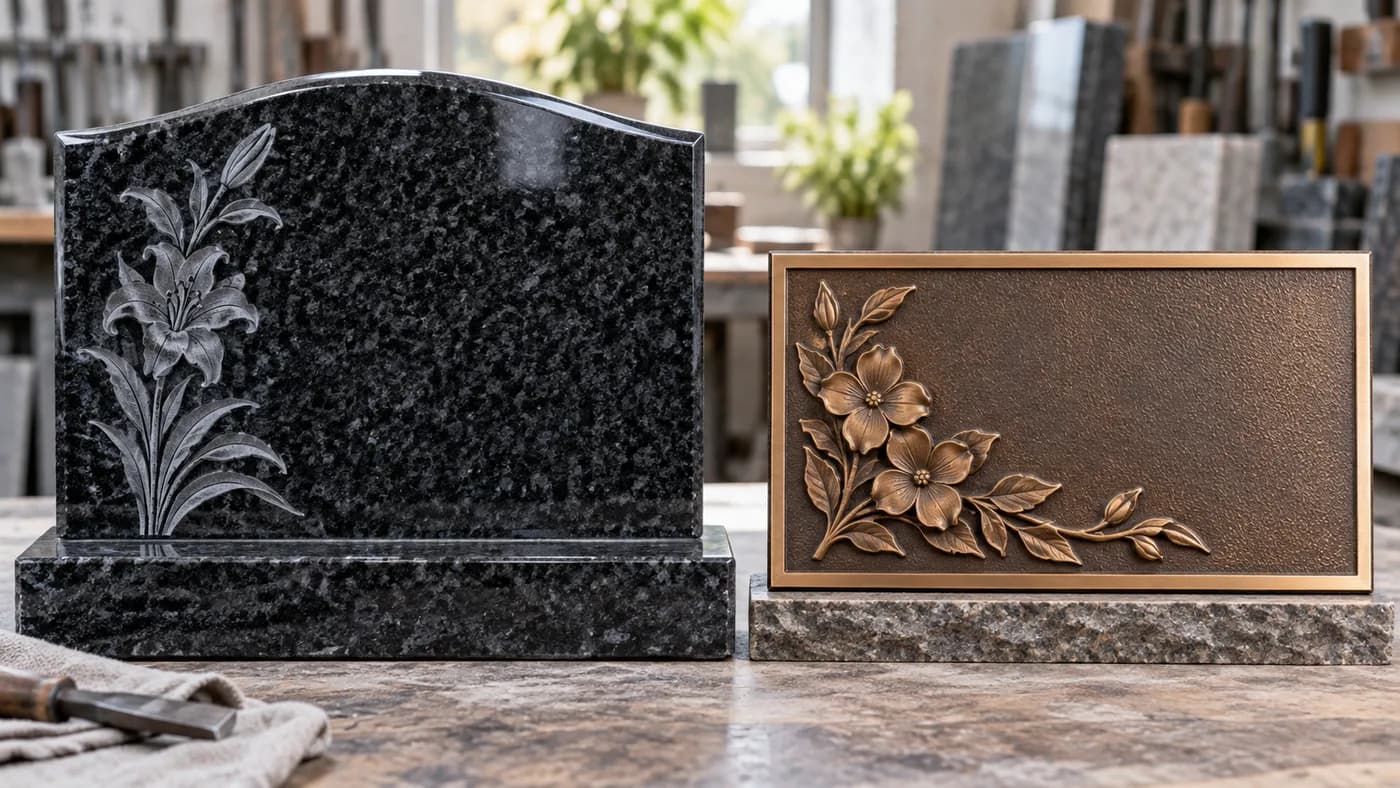
Roughly is enough. You need a style, an approximate size, a material, and a sense of what goes on the stone — names, dates, an epitaph, any artwork, a portrait, a vase. See headstone types and styles, granite colours and finishes, and headstone engraving.
"Not sure yet" is a legitimate answer to any of it. A monument company can recommend a size and a configuration — that is part of what you are hiring them for.
Step 4 — Get quotes you can actually compare
Quotes differ far more in what they include than in what they charge. Before comparing totals, make sure you know, for each quote: does it include the base, the lettering as you specified it, delivery, the foundation, and the setting? Is sales tax in or out?
That is the purpose of the request form on this site: you describe the memorial once, in structured questions, and monument companies quote against the same specification. Quotes are sealed — companies quote independently and do not see each other's prices. Your email address and phone number are not shared with any of them while you are requesting or comparing.
For what belongs in a total, see how much a headstone costs.
Step 5 — Choose a monument company
Compare on inclusions, what the company says about warranty and completion time, and how clearly they answer questions — not on the headline number alone. If the person was a veteran, ask whether the company has handled VA-furnished markers before; the paperwork and the setting differ from an ordinary order.
If your design includes a porcelain photo or vases, there is one more step before anything is final: the company confirms that the photo and vases will physically fit on the monument face alongside the lettering. They may come back proposing a different photo size or shape, a different vase, or a larger monument. That is normal, and it is better to hear it now than after fabrication. See porcelain photos vs. laser-etched portraits.
Step 6 — Approve the design proof
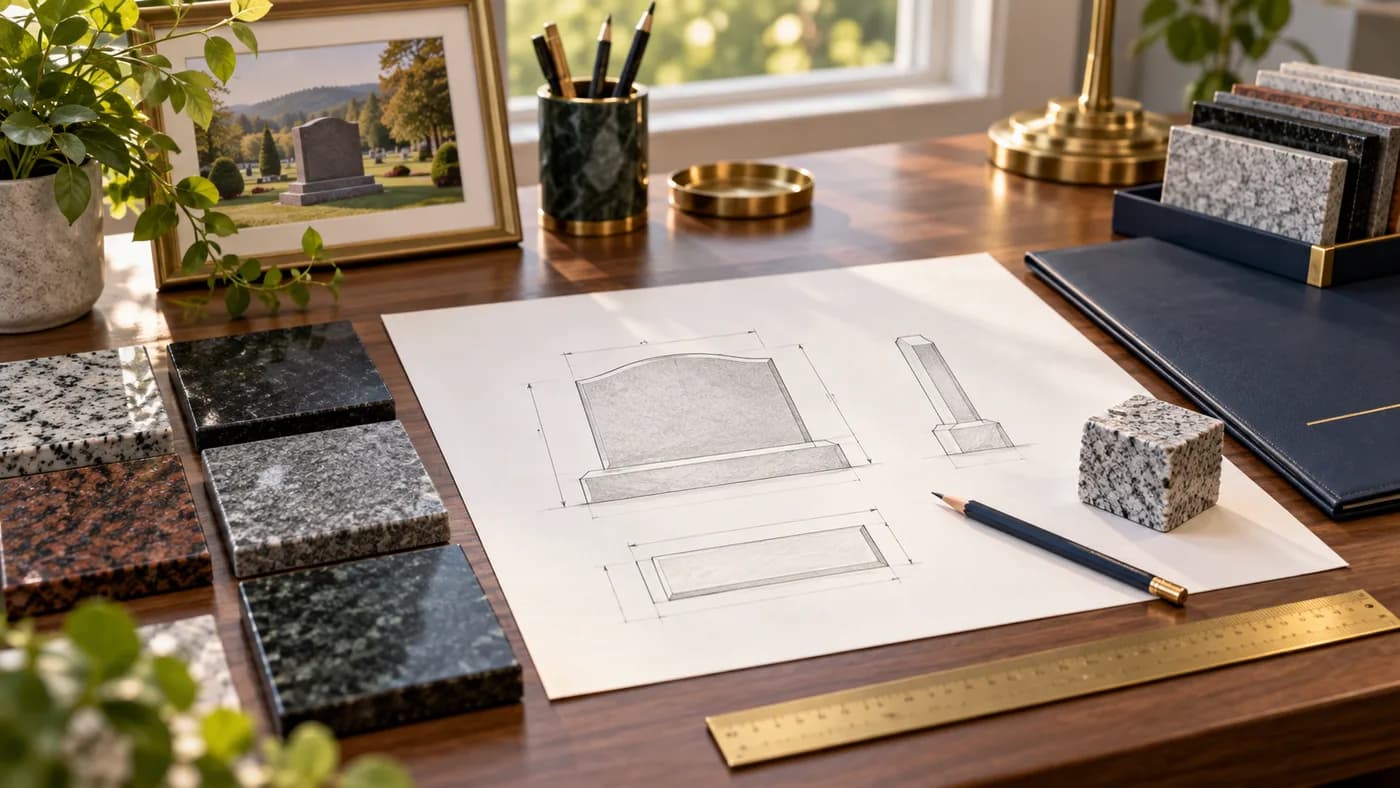
A proof is a scaled drawing of your marker showing the stone's shape and size, the exact inscription, the layout, and any artwork. Read it letter by letter. Once you approve it, it is what gets cut, and stone does not have an undo.
Check the spelling of every name, every date, the epitaph word for word, and that nicknames, middle initials and suffixes are exactly as you want them. Have a second family member check it too. What to look for in detail is covered in headstone engraving.
Step 7 — Fabrication
The stone is cut to size and finished, the inscription is sandblasted or laser etched, and any portrait, emblem or vase hardware is added. Specialty colours may need to be sourced; custom shapes take longer than standard ones.
Step 8 — Foundation and setting
A concrete foundation is poured if the cemetery requires one and none exists, then the marker is delivered and set. Depending on the cemetery, the foundation and setting may be done by the cemetery's own crew, by the monument company, or by both — and billed accordingly. Weather matters here: pouring concrete and working with heavy stone in frozen or saturated ground is often not possible, and in colder regions setting work can be deferred to a later season. Ask your cemetery and your monument company what applies where you are.
Step 9 — Inspect the finished marker
Visit once it is set. Check the inscription against your approved proof, check that the marker sits level and square, and check that any photo, vase or emblem is mounted as agreed. Raise anything that is wrong promptly and in writing.
How long does it take?
We will not give you a number, because an honest one does not exist at national scale — and a made-up one would be worse than nothing.
What we can tell you is what the timeline is actually made of:
- How quickly cemetery approval comes back. Often the largest variable, and entirely outside the monument company's control.
- How long you take to approve the proof. Families frequently take longer here than they expect, and that is fine.
- Stone availability. Common granite colours are stocked; specialty and imported colours may need to be ordered.
- Complexity. A standard flat marker with two lines is not a carved companion upright with a portrait.
- Season and region. Foundation work depends on ground conditions.
- Whether a VA-furnished marker is involved, which adds a federal application step.
Ask each monument company for their own estimate in writing, and ask what would make it slip. A company that gives you a range and names its risks is telling you more than one that gives you a confident single date.
What to gather before you start
- The cemetery's name, address, and the section, lot and grave identifiers if you have them.
- Proof of who holds the interment right, or the cemetery's confirmation.
- The cemetery's written rules or approval form, if it has one.
- The full legal name, birth date and death date, spelled and formatted exactly as you want them cut.
- Any epitaph text, emblem or artwork you want, written out.
- The photograph, if you want a portrait — see how to get a picture for a headstone.
- For a veteran: discharge documents (such as a DD214).
Where it most often goes wrong
| What happens | Why | How to avoid it |
|---|---|---|
| The cemetery refuses the design | It was never approved in writing | Step 2, before ordering |
| A surprise bill after setting | Foundation or setting fee was the cemetery's, not the monument company's | Ask both parties who charges what |
| A misspelling in the stone | The proof was approved quickly, in grief | Two people check the proof, slowly |
| The photo does not fit | Photo, vases and lettering compete for the same face | Confirm the layout before finalising |
| Long unexplained delay | Approval or stone sourcing, usually | Ask what the timeline depends on, up front |
Frequently asked questions
Do I have to buy the headstone from the cemetery? That depends on your cemetery's policy and your state's law. It is not settled by a single federal rule — the FTC Funeral Rule expressly "does not apply to third-party sellers, such as casket and monument dealers, or to cemeteries that lack an on-site funeral home." We explain what that does and does not mean in the cemetery requirements guide. This is a description of a rule's scope, not legal advice.
Can I order a headstone before the burial? Yes, and many families do, including for themselves. The cemetery approval step still applies.
When do I pay? Terms vary by company. Ask for the payment schedule in writing along with the quote, and ask what happens if the cemetery rejects the design after you have paid.
Who installs it? Depends on the cemetery. See Step 8 — and ask before you order.
Request written quotes
Describe the cemetery, style, material, and inscription once, then deliberately send a serious inquiry to participating monument companies for real prices.
Request free quotesSources and scope
This guide provides general educational information, not a quote or a statement of any cemetery’s rules. Confirm requirements and prices directly with the cemetery and monument provider.