Remembering a wife
Headstones for a Wife: Prices, Wording, and Buying Guide
Plan a memorial for your wife with personal inscription ideas, companion options, itemized cost questions, cemetery rules, and ordering steps.
Published by HeadstoneQuotes · Sources last verified October 5, 2026 · 11 min read
Last source review: October 5, 2026. U.S. buying guide.
Choosing your wife's headstone can feel like being asked to reduce a whole person and partnership to a few lines. You can make the decision smaller and more manageable: establish the grave's rules, choose a shape and total budget, verify the identifying details, then decide whether one personal line adds something true. A complete marker does not need to explain every role she had or everything your family will miss.
This guide addresses prices and the purchase process, including the question of a shared stone. It also offers original inscription ideas you can adapt. Her own preferences, the cemetery's requirements, and the people authorized to approve the memorial should guide the final result.
How much will a headstone for your wife cost?
There is no relationship-specific price. The cost follows the physical design and the work required to place it. Empathy's U.S. guide gives an approximate $1,000–$3,000 for a headstone including installation, with much wider ranges for different marker styles. Funeral Consumers Alliance notes that engraving may be charged separately and installation can cost several hundred dollars. These are published estimates, not local quotes or prices collected by Headstone Quotes. They cannot tell you what the finished stone will cost at her cemetery.
Ask for a total covering the marker, any base, inscription, image or emblem, freight, foundation, setting, cemetery fees, and tax. The seller and cemetery may bill different parts. Confirm whether the displayed price includes the amount of lettering you need and whether the proposed dimensions include a base. For an added photograph or vase, ask for a separate line item. The headstone cost guide gives a fuller checklist of cost categories.
If the initial proposal exceeds your budget, ask for priced changes to size, finish, carving, and artwork. Keep the exact inscription when comparing those revisions so you can see what the design change saves. A seller should be able to explain the tradeoff in readability and appearance, not only the dollar difference. Plan for future lettering if the stone will eventually bear another name.
Get the exact cemetery requirements
The Federal Trade Commission advises that cemeteries differ in the memorials they permit. Ask the cemetery for current written rules for your wife's section, not just a general brochure. Verify marker type, maximum and minimum dimensions, material, finish, foundation, inscription and attachment rules, and who can perform installation. Ask for approval steps, a current fee schedule, and a contact who can answer the seller's technical questions.
The cemetery may accept upright markers in one section and only flat markers in another. Neighboring stones may have been installed under older rules. Confirm the grave, lot, and section on the paperwork before commissioning a drawing. If the marker is to span two plots, ask whether those plots are eligible for a shared foundation and who holds the rights to both.
The person paying for the stone may not be the person the cemetery requires to authorize it. Check the plot deed or cemetery record and identify who will sign the application and final proof. Where a family plot or prior arrangement is involved, resolving those rights first can prevent an expensive design revision later.
Select a form before filling it with words
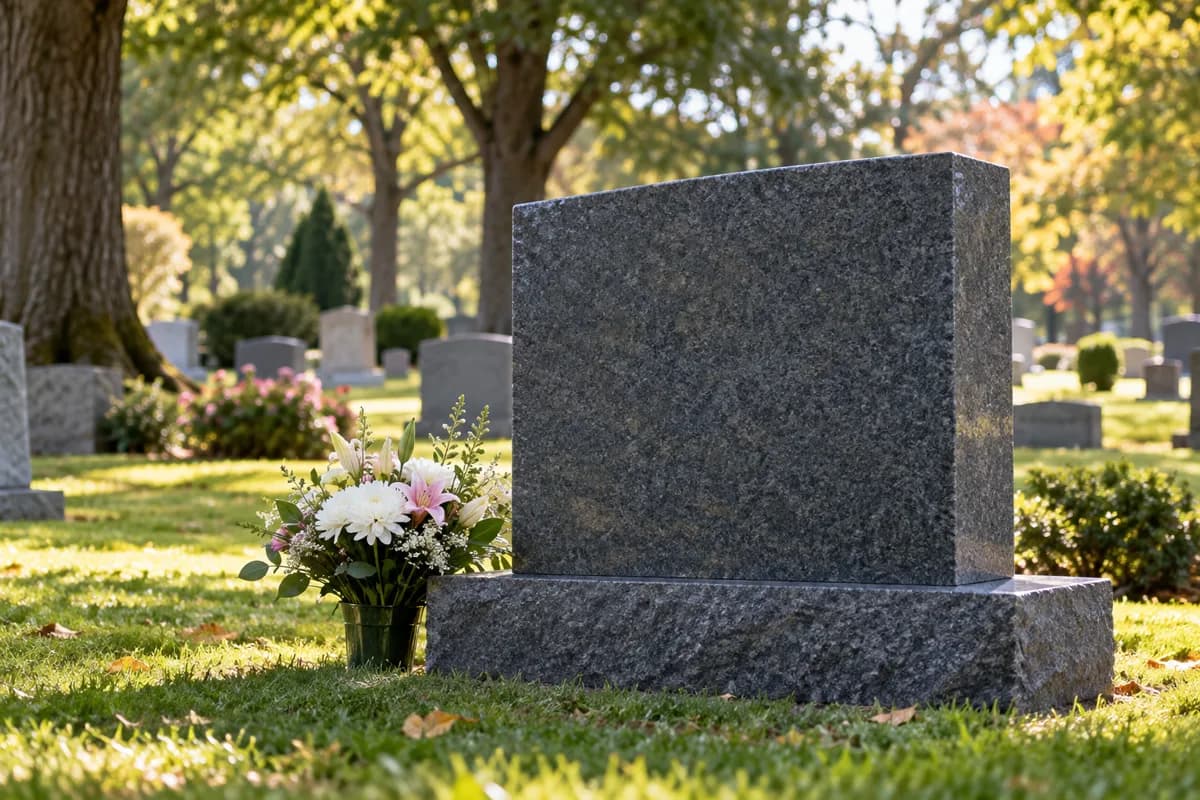
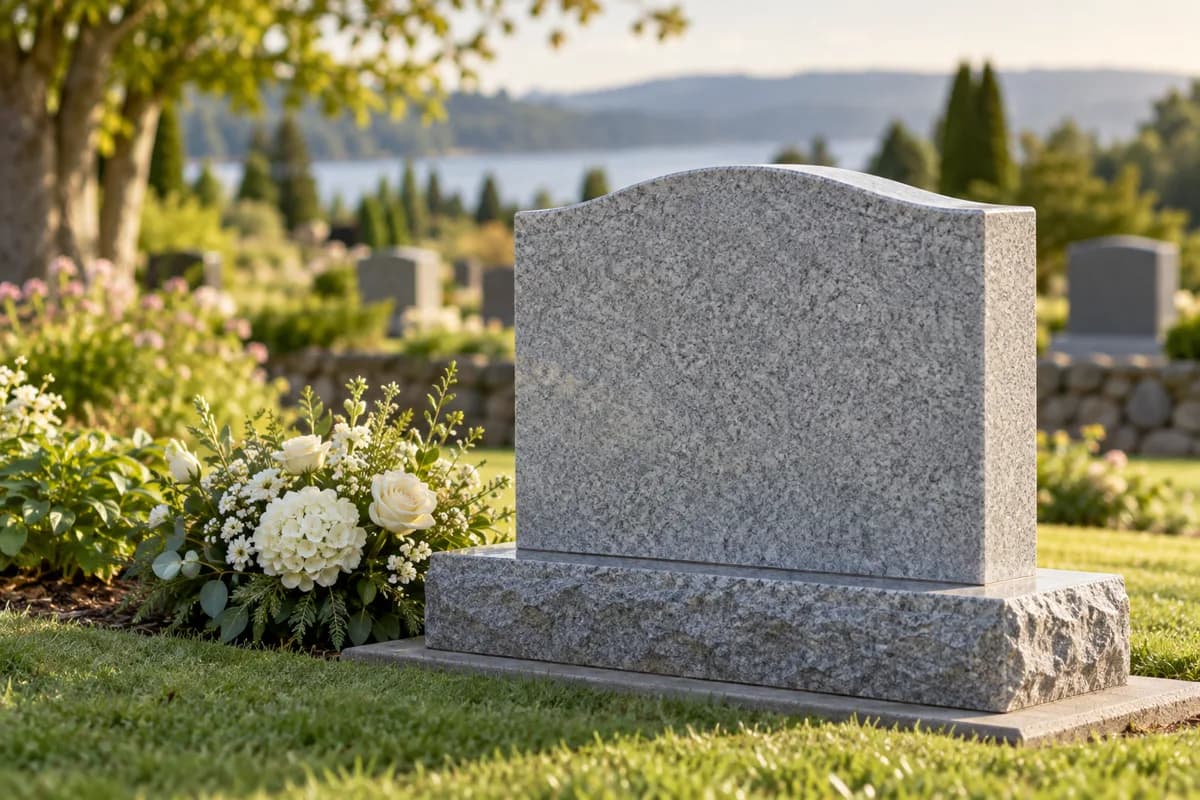
An upright marker provides a vertical face visible from farther away and often room for two names or longer text. A flat marker can be quieter and may be required in a lawn section. Slant and bevel stones offer angled faces with less height. Each can be dignified. Choose among the cemetery's permitted types, then compare actual dimensions. The layout should be legible from a normal standing distance, not merely on a zoomed screen.
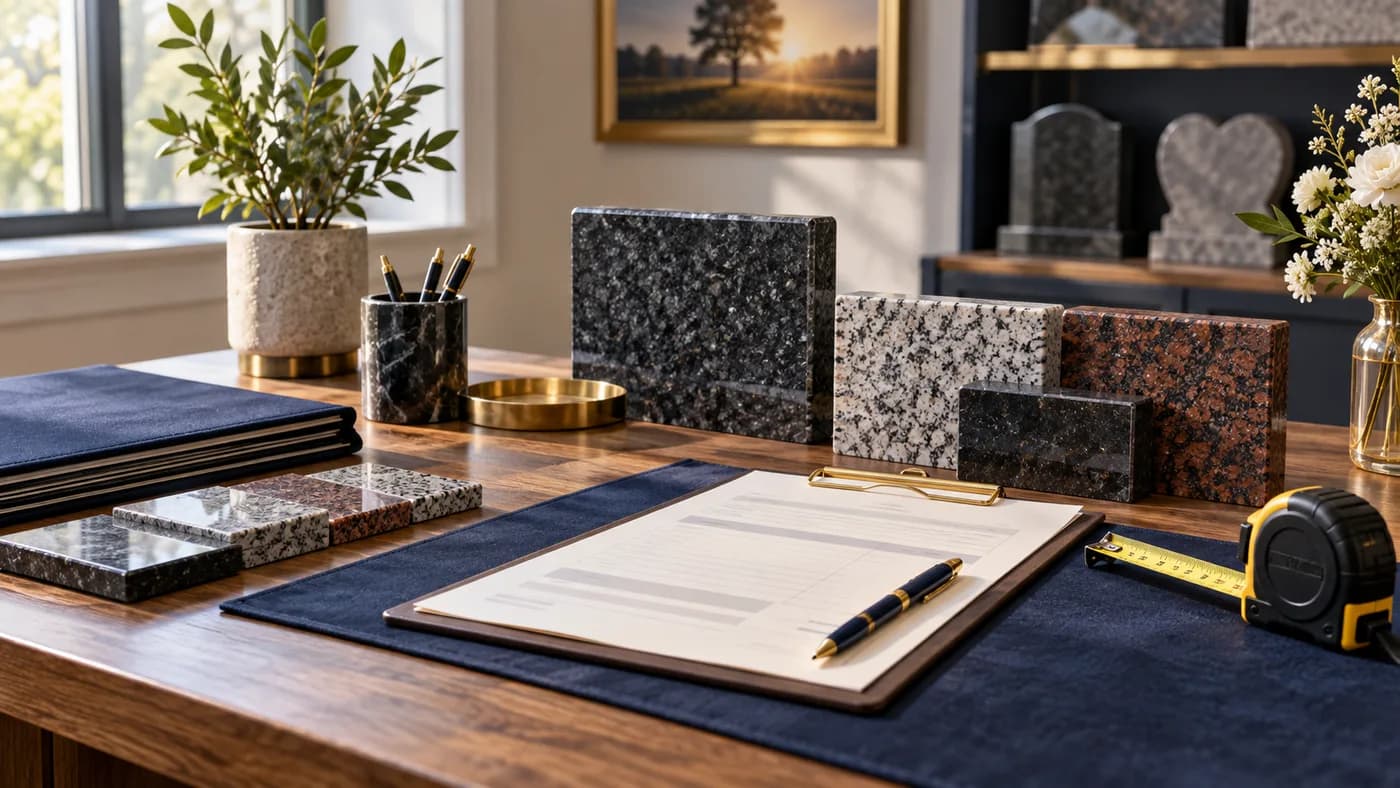
Granite is available in varied colors and finishes; its grain and finish affect the contrast of lettering and etching. Bronze and marble may be allowed at some cemeteries. Ask to see finished work in the material and lettering method proposed. If you want a portrait, request a sample of an etching or insert and ask how it is secured, cleaned, and replaced. Ask the maker what resolution and cropping the source image requires.
A decorative motif should come from her life, not a generic assumption about wives. A plant she grew, a place she loved, a musical instrument, a faith symbol, or a simple geometric border can each be appropriate. A plain stone can be equally personal when its shape, name, and wording feel right. Ask the seller to show a version without the ornament; that makes it easier to judge whether the detail improves the memorial.
Decide whether to share the marker
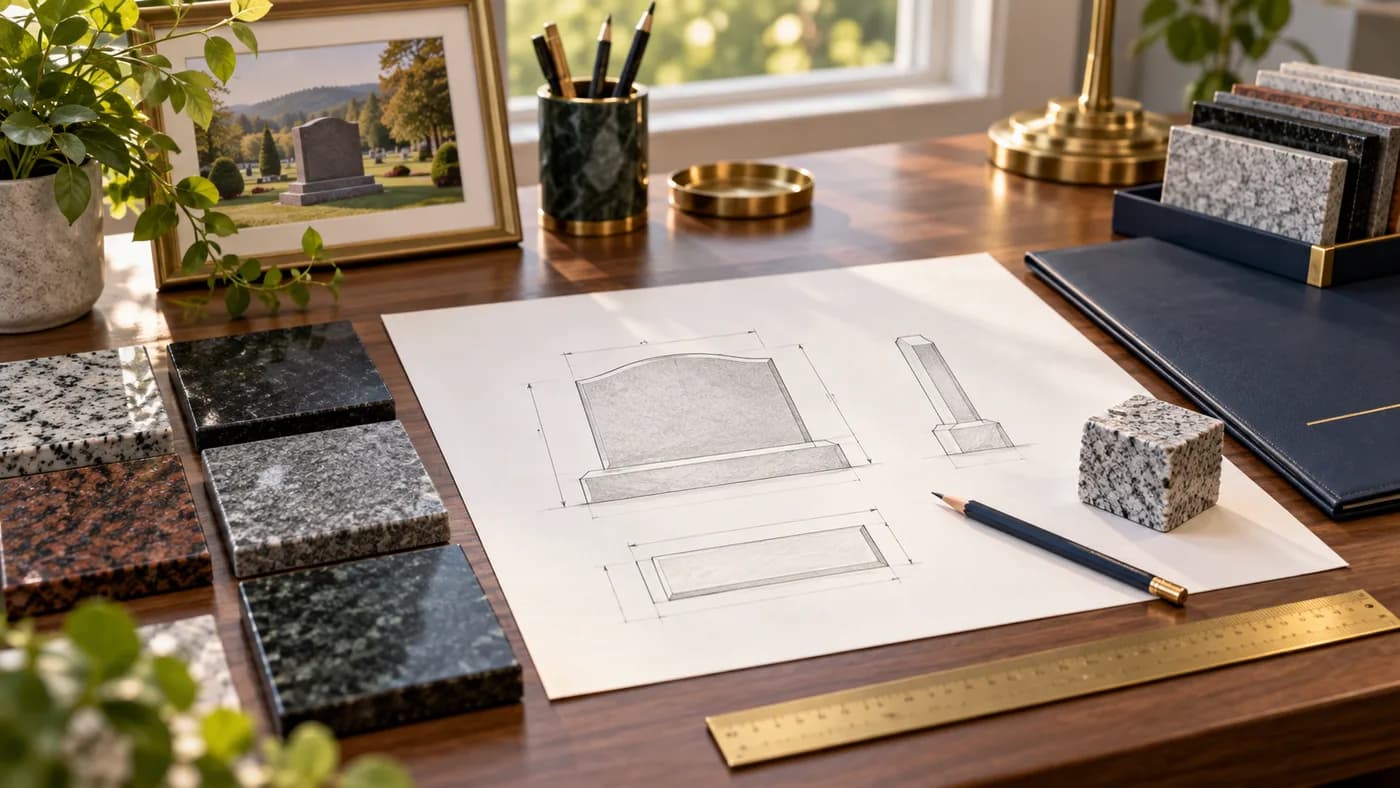
A companion headstone can mark a couple together and reserve room for a second name. A separate stone can give your wife a design entirely her own. The choice depends on burial plans, plot rights, her wishes, and cemetery rules. Do not assume that two adjacent graves permit one marker across them. Ask about the permitted width and foundation and obtain a scaled drawing.
If your own name may be added later, review the stone in two states: as it will be installed now and as it could look when complete. Decide whether to engrave your name today, leave space only, or omit the future plan. Ask how later lettering is done and whether the stone must be removed. Get a current estimate for that work while recognizing future prices will change. The seller should tell you whether its chosen finish and lettering style can be matched.
This can also be a difficult emotional decision. You need not turn a memorial for your wife into a decision about your own epitaph. A design with enough space and no prewritten future line may be a good solution. Make sure any placeholder text in a drawing is labeled clearly and excluded from the fabrication order.
Write the name and personal line carefully
Begin with how she wanted to be named. Check spelling, birth and death dates, middle or family names, and accents against reliable records. If she changed her surname, consider which names she used and wanted remembered; there is no universal requirement to put a marriage surname first. Ask the cemetery about any naming restrictions, then lay out the chosen form at the proposed letter size.
One personal line can be enough. Avoid a generic description that could fit anyone. Think about her curiosity, work, humor, commitments, favorite places, or what she and others built together. A phrase can speak from a spouse's point of view without eclipsing her identity.
Original lines to consider and adapt:
- “We found our way together.”
- “She asked good questions and lived the answers.”
- “Her courage made room for ours.”
- “Our days were brighter for her company.”
- “She kept wonder close.”
These are examples, not statements about your wife. Her name alone, perhaps with “Loved always,” may be the most faithful choice. If she left written wishes, give those priority while checking that the text fits and is permitted. For a line from a song, book, or poem, verify the wording and any permission needed to reproduce protected text. Family-written wording is often more direct and avoids rights uncertainty.
If she used more than one language, decide whether the stone should too. A translation can change tone and take more space. Ask a fluent person to review both the meaning and the exact characters on the final proof. Make sure the seller can reproduce accents and scripts accurately in the chosen carving method.
Organize the family review
Set a small decision group that includes the people with legal or cemetery approval rights and those whose input you and she would have valued. Ask for specific memories and wording, then circulate a proposed layout. Too many separate suggestions can produce an unreadable stone. A shortlist of two designs, both within cemetery rules and budget, gives everyone something concrete to discuss.
If children, parents, or relatives have different views, separate factual corrections from preferences. Everyone should be able to correct a date or spelling error. The final wording needs a clear approver. A marker need not list every family relationship, especially if doing so risks omission. The stone is one memorial; an obituary, gathering, or family archive can carry the fuller account.
Give the final proof to a second reader who did not compose it. Ask them to compare each name and number with records, read every letter, and check the graphic balance at the actual dimensions. Any revision should produce a new proof for approval. Once stone is carved, a simple typo can be hard to correct cleanly.
Compare complete quotes and responsibilities
Give each supplier the same grave details, cemetery rules, stone type, dimensions, material, finish, exact inscription, and artwork request. Obtain a written itemization for the stone, base, lettering, design revisions, shipping, foundation, installation, cemetery fees, and tax. Identify which party charges and performs each step. Ask who submits the plan to the cemetery and what happens if approval is denied.
Compare timelines for proof, fabrication, delivery, and setting. Ask whether dates are estimates or commitments and how the supplier handles cemetery delays or weather. Review cancellation terms, payment schedule, damage claims, and workmanship warranty. An online stone price may exclude local setting and other charges; a local package may include them. You can compare only after those differences are made explicit.
Before signing, confirm the final proof number or date on the order. Keep copies of the cemetery approval, drawing, invoice, payment receipt, and installation record. These are useful if you later add lettering, replace a photo insert, or question a mistake.
Practical order of work
- Verify the grave and the person authorized to order its memorial.
- Obtain written section rules and cemetery fees.
- Set a full-cost budget and choose a permitted marker type.
- Verify her name, dates, and any chosen personal line.
- Request identical-specification, itemized quotes from multiple sellers.
- Review the scaled proof, including any plan for future lettering, and get cemetery approval.
- Confirm payment, production, shipping, foundation, and installation responsibilities in writing.
- Inspect the finished memorial and keep the paperwork.
Ask the cemetery when it will accept the foundation and setting after burial. Production and installation schedules vary; neither a general web estimate nor a hoped-for date should replace confirmation from the parties doing the work.
Frequently asked questions
Should the stone say “wife,” “mother,” both, or neither?
Use the words she and the family would recognize. Relationship labels are optional. A name and dates may leave more room for a distinctive short line. If relatives disagree, a simpler inscription can prevent one role from seeming to define her entire life.
Can I put my own name on the stone now?
Usually this depends on plot rights, cemetery rules, and your preference. Ask to see a proof both with and without your name. Confirm precisely what will be engraved now and how later dates or lettering would be added.
Are portrait inserts durable?
Durability varies by product, attachment, exposure, and care. Ask for the supplier's written specifications, warranty, and replacement process. Also check whether the cemetery permits the insert. View a real installed example if possible.
What if I want more time before choosing wording?
Ask the cemetery about its schedule and any marker deadline. You can gather rules and quotes while taking time with the inscription. Do not approve temporary or placeholder wording for carving unless you truly want it permanent.
Can a different company install a stone bought online?
Possibly, subject to the cemetery's rules and an installer's willingness to accept the stone. Confirm receiving, inspection, foundation, setting, and responsibility for shipping damage before ordering. Compare the final installed price with local offers.
Move from ideas to a quote
With the cemetery's written requirements and a verified inscription draft, ask two or more providers for the same installed design. Review upright headstones, flat grave markers, and headstone costs if you are still choosing a shape or budget.
Source and scope note: This guide addresses U.S. purchases. National price context is attributed to Empathy and Funeral Consumers Alliance; cemetery-rule context is attributed to the FTC. It is not a local price survey, and the example epitaphs are original suggestions. Confirm current cemetery requirements, authority to order, and all charges for the specific grave.
Request written quotes
Describe the cemetery, style, material, and inscription once, then deliberately send a serious inquiry to participating monument companies for real prices.
Request free quotesSources and scope
This guide provides general educational information, not a quote or a statement of any cemetery’s rules. Confirm requirements and prices directly with the cemetery and monument provider.