Remembering a husband
Headstones for a Husband: Prices, Wording, and Buying Guide
Choose a memorial for your husband with clear options for wording, single or companion designs, total costs, cemetery approval, and ordering.
Published by HeadstoneQuotes · Sources last verified October 5, 2026 · 11 min read
Last source review: October 5, 2026. U.S. buying guide.
When you choose a headstone for your husband, you may be making a decision about your own eventual memorial too. A shared grave can invite a companion design, while separate graves or a preference for individual markers call for something else. You do not have to decide every future detail now. First establish what can be installed at his grave, what you can spend, and which parts of the inscription you are ready to approve.
There is no standard price for a “husband headstone.” The relationship changes the design conversation, especially around a spouse's name and future lettering, but the bill follows the same physical work as any memorial: stone, carving, delivery, foundation, and setting. This guide focuses on the choices that tend to matter when one spouse is ordering for another.
Build an installed-price budget
Empathy publishes a broad U.S. estimate of about $1,000–$3,000 for a headstone including installation and lists wider ranges for particular styles. Funeral Consumers Alliance notes that engraving may be extra and installation can cost several hundred dollars. These are outside estimates, with no local cemetery calculation. They should prompt questions, not set a target price for your husband's stone.
Request the total for a completed, permitted, installed design. The marker, base, lettering, artwork, delivery, foundation, cemetery review or setting, and tax may appear on different invoices. A companion stone can be larger and require more lettering, but its price cannot be inferred simply by doubling a single marker quote. Compare exact dimensions and inclusions. Our headstone cost guide explains each line item.
If a shared stone is possible, ask for two written options: one with only his completed inscription and one designed for two names. Include the expected process and current quoted fee for adding later lettering. The future charge may change by the time it is needed, so treat it as a planning item, not a guaranteed price. Also ask whether a separate second marker would be permitted on the plot. You can then choose based on how the stone will look and how future work will be handled.
Check burial rights and cemetery rules
Get the current written rules for his exact cemetery section. The FTC says cemeteries differ in the monuments and memorials they allow. Some sections are limited to flat markers; others allow upright or companion memorials. Ask about maximum width, thickness and height, approved materials, foundation requirements, inscriptions, photography, and any rules for multiple names on one stone. Ask who approves the drawing and who can install.
Confirm the plot record and the person authorized to order a memorial. A surviving spouse may be the decision maker, but ownership and cemetery policies should be checked rather than assumed. If he owned a shared plot, learn how the second interment and future inscription are handled. If the grave is part of a family plot, other right holders may need to participate. Resolve this before paying a nonrefundable deposit.
Request the cemetery's fees separately from the seller's estimate. Ask whether the cemetery supplies the foundation or requires an approved contractor. If the stone is made elsewhere, identify who receives it and is responsible for damage before installation. A seller experienced with this cemetery should still show you the governing written specifications.
Single, companion, or family marker?
A single marker can focus entirely on him. It may be appropriate when plots are separate, when a partner does not wish to reserve their own inscription, or when the family wants each life marked individually. A companion stone gives two people a shared face; it can express a partnership and avoid a later mismatch between neighboring stones. A family monument may carry a surname with individual foot markers, if the cemetery permits that arrangement.
Look at the layout as well as the price. If a second name will be added later, will the first inscription appear off-center for years? Is a blank date line helpful or unsettling? Would you prefer a shared surname at the top and individual names below? Ask the designer to show both the present-day appearance and the completed future layout. Check whether the stone can be lettered in place later and whether the finish or carving method can be matched.
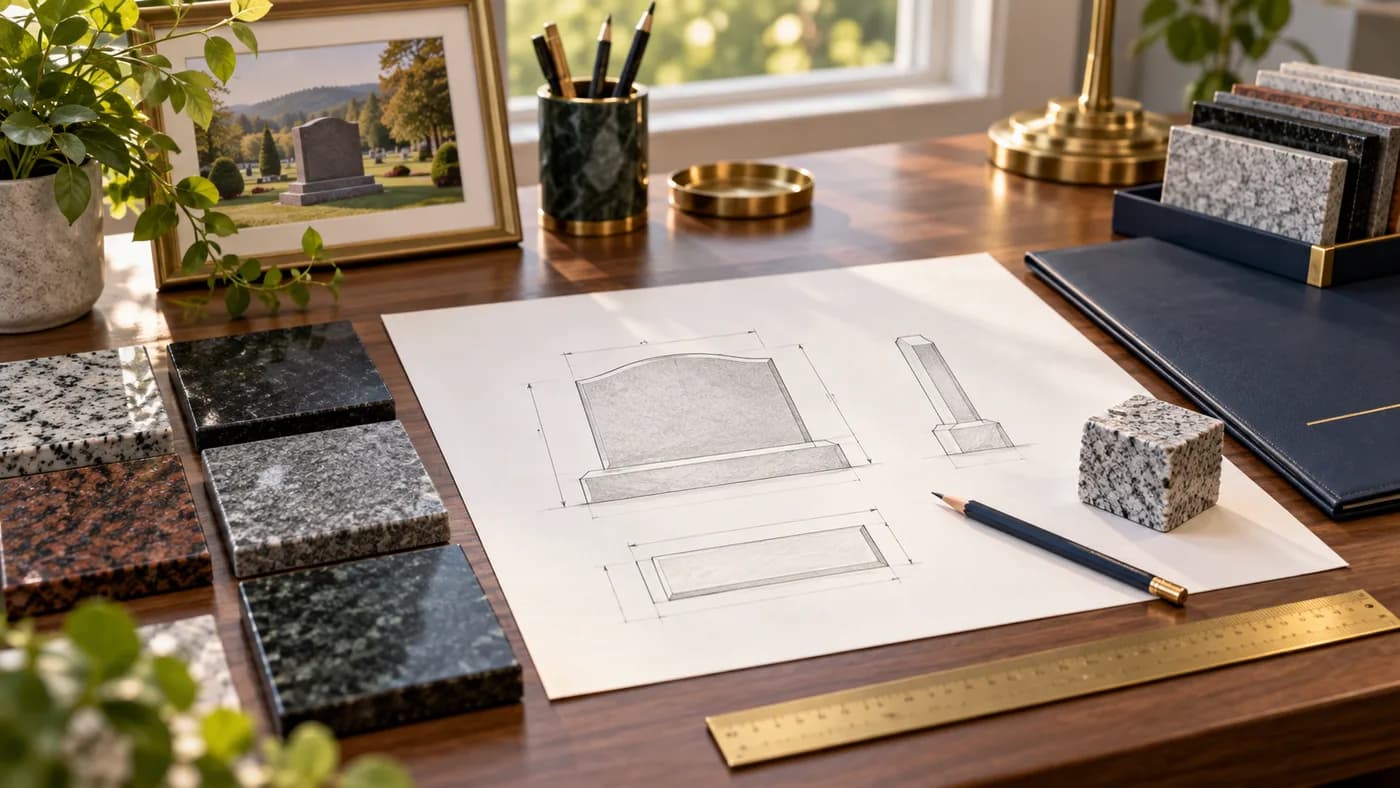
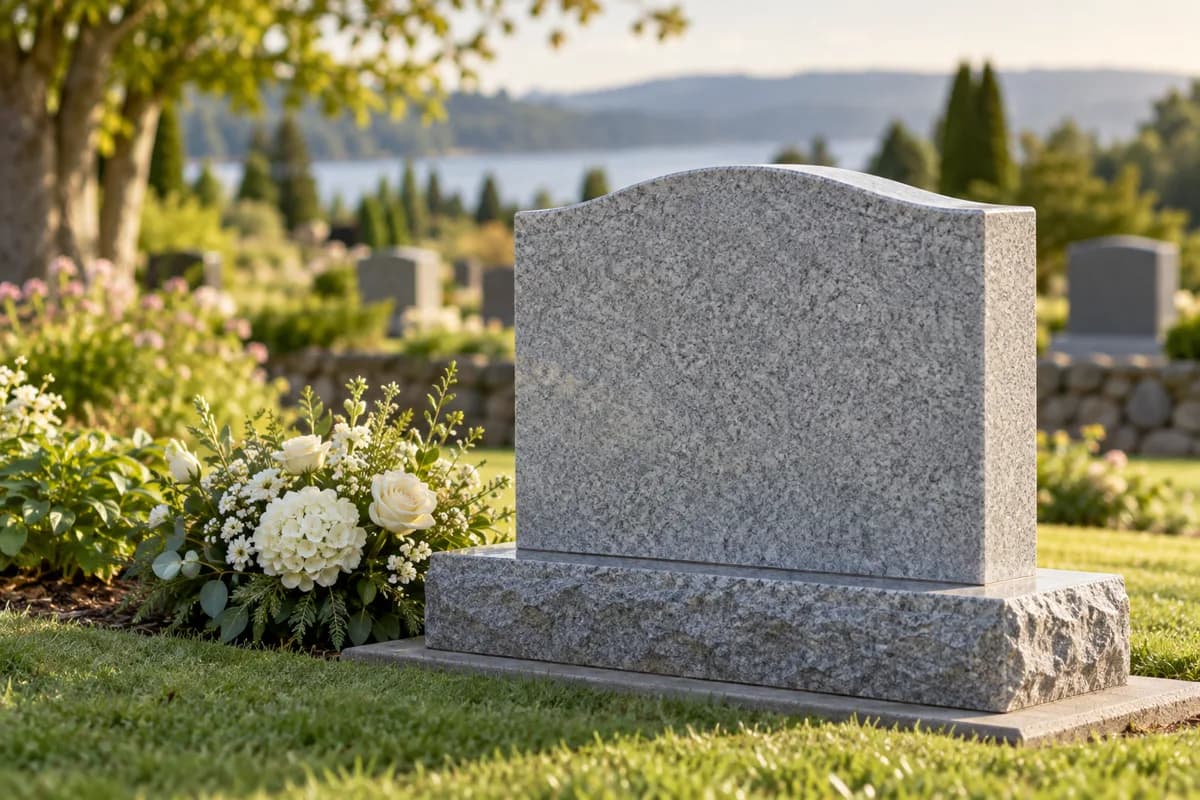
Shape matters because it controls readable space. An upright can hold more text and stand visibly at the grave. A flat marker often keeps the design concise and may be the only permitted choice. Slant and bevel markers offer angled faces at lower height. Granite, bronze, and sometimes marble have different finishes and maintenance considerations. Ask to view an actual finished example. A computer rendering is useful for spacing but cannot fully show natural stone color and grain.
Choose words that describe this marriage and this person
Check his preferred name, all dates, and any title against records. Decide whether a nickname belongs in the main name line or a smaller line. A phrase such as “Beloved husband” may fit, but you can be more specific without making the stone long. Think about what was distinctive in daily life: a shared habit, a promise kept, the way he welcomed others, or something he helped build. The inscription need not summarize the whole marriage or imply that his spouse is the only person who mourns him.
Original example lines to adapt:
- “We made a good life, one day at a time.”
- “Your hand was home to mine.”
- “He kept his word and opened his door.”
- “Loved for the life he shared and the lives he touched.”
- “Still part of every road we take.”
A religious line, a shared language, or a symbol from a meaningful place can be appropriate if it reflects him and meets cemetery rules. Avoid placing a private joke on the stone until you have seen it outside the family's immediate context. It will be read by relatives and strangers for many years. If you want to reproduce a song lyric or poem, check rights and permission or write a fresh line. Have a fluent reader review any wording in another language, especially diacritics and line breaks.
If you are preplanning your own line, you can approve the general layout now without committing to a final epitaph for yourself. Ask exactly what the seller will engrave today. A proof showing placeholder dates or text should say clearly whether those marks are for layout only. Never assume a blank line can be repositioned after the stone is cut.
Handle family input with a clear approval path
Children, parents, and siblings may all care deeply about the marker. Invite suggestions, but identify who has authority to sign the final proof. If your husband expressed wishes, share them early. A single page showing the cemetery limits, budget, and two or three design options helps relatives respond to real choices. Ask for feedback by a specific date before the proof is approved.
For remarriages and blended families, a spouse inscription can be emotionally complex. A neutral name and dates may be the right choice if relatives disagree about relationship wording. A memorial is not required to list all family roles. You can preserve fuller stories elsewhere and keep the stone legible. If a prior spouse shares the plot or a family monument, ask the cemetery about rights and existing design before deciding how names will appear.
Give the proof an independent fact check. Grief and familiarity make it easy to read the intended spelling instead of the printed one. A person who has not worked on the design should check every character, number, and accent against your source records. Recheck after each revision.
Compare sellers with the same specification
Send each seller the cemetery rules, grave identification, desired shape, dimensions, material, finish, inscription, and any shared-stone plan. Request an itemized written price for stone, base, lettering, artwork, proof revisions, freight, foundation, setting, cemetery fees, and tax. Ask what is due at order, at proof approval, and at installation. Confirm the treatment of changes or cancellation after carving begins.
Ask who submits the drawing for cemetery approval and who resolves a rejection. Ask about manufacturing and delivery estimates, installation scheduling, damage in shipment, workmanship warranty, and what natural color variation is expected. If an online seller quotes only the stone, you still need a local party willing to receive and install it under cemetery rules. Compare complete totals and responsibilities, not photographs of unlike products.
Once you choose a provider, retain the drawing, order, invoice, written cemetery approval, and contact details. These records will matter if lettering is added years later or an attachment needs repair.
An order sequence that protects the design
- Confirm grave location, burial rights, and the authorized purchaser.
- Obtain current cemetery specifications and fee schedule.
- Decide whether the memorial is for him alone or designed for two people.
- Verify all names, dates, and exact inscription wording.
- Seek comparable itemized quotes and ask about future lettering.
- Review a proof at actual dimensions; check today's appearance and any planned second inscription.
- Confirm cemetery approval and written responsibilities for delivery, foundation, and installation.
- Inspect the finished stone and keep the documents for future changes.
There is no need to rush from the burial to a permanent inscription unless a specific cemetery or family circumstance creates a deadline. Ask the cemetery when it will permit setting, and ask the seller what production time it can currently support.
Frequently asked questions
Should my name appear on my husband's headstone now?
It is a choice, not a requirement. You can reserve visual space without engraving your name, or choose a stone dedicated only to him. Check the plot rights, cemetery rules, appearance of the partial layout, and process for future lettering before deciding.
Can we add his name to an existing companion headstone?
Possibly. A monument professional needs to inspect the existing stone, available space, lettering style, and access. The cemetery must permit the work, and the right holder must approve it. Ask for a written layout and total price before authorizing carving.
Is a companion headstone always more economical?
No universal comparison holds. A larger stone and additional lettering can raise today's price, while two separate markers can carry separate foundations or setting charges. Ask for both permitted options with complete installed totals.
What if we disagree about a phrase like “beloved husband”?
Use his name and dates while the family discusses the rest. An epitaph is optional. If a relationship line carries conflict, a short description of his character or a shared memory may be easier to support.
Can a veteran's spouse get a VA headstone in a private cemetery?
Do not assume so. VA's headstone and marker guidance says spouses and dependents are not eligible for a government-furnished headstone or marker in a private cemetery unless buried in a national, state Veterans, or military cemetery. Eligibility rules and benefits should be checked with VA for the actual burial situation.
Request a complete quote
Bring the cemetery's rules and your preferred layout to two or more suppliers. Ask each for the same finished design and a clear plan for any later inscription. For style details, see upright headstones, flat grave markers, and our headstone cost guide.
Source and scope note: This is a U.S. planning guide. Empathy and Funeral Consumers Alliance supply published national cost context; the FTC supports the cemetery-rule warning; VA supports the specific veteran-benefit answer. Prices and cemetery permissions must be verified locally. The inscription examples are original editorial suggestions, not historical quotations.
Request written quotes
Describe the cemetery, style, material, and inscription once, then deliberately send a serious inquiry to participating monument companies for real prices.
Request free quotesSources and scope
This guide provides general educational information, not a quote or a statement of any cemetery’s rules. Confirm requirements and prices directly with the cemetery and monument provider.